 RWF
 KES - Kenya
 UGX - Uganda
 TZS - Tanzania
 NGN - Nigeria
 ZAR - South Africa
 USD - Zimbabwe
 GHS - Ghana
 ETB - Ethiopia
 ZMW - Zambia
 USD - International

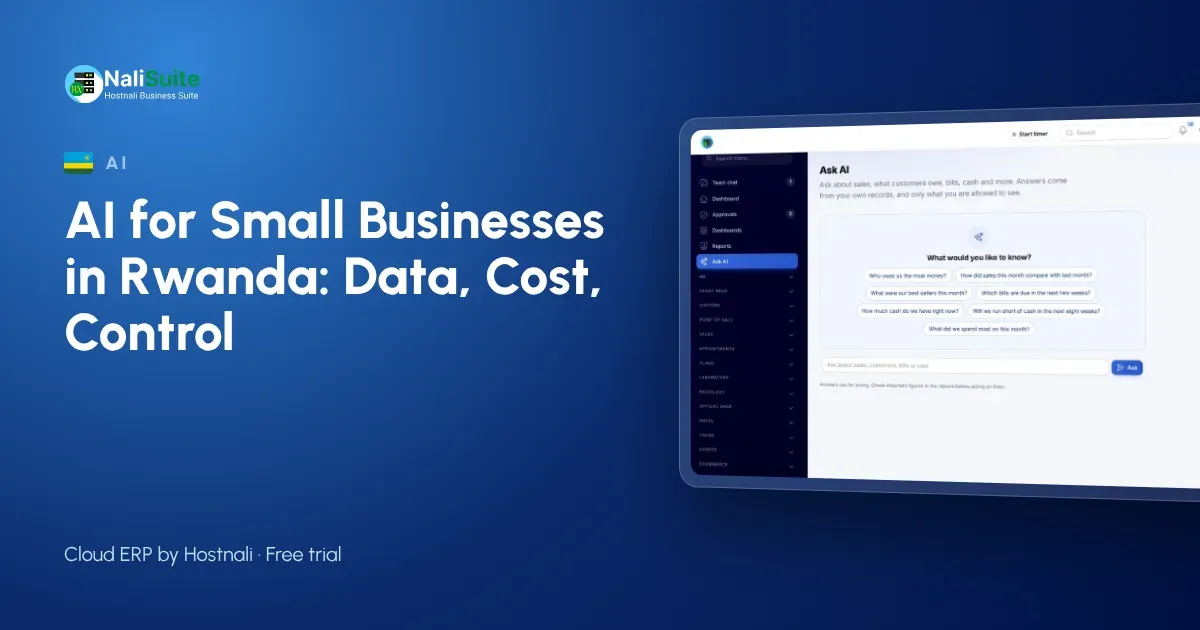
Rwanda has built a reputation for taking technology seriously, and many Kigali businesses are keen to use AI. The more careful ones ask first: what happens to our data, what will it cost, and who stays in control?
This guide answers those three questions for a small business, then shows the practical uses that are worth the effort.
Control: a person signs off
The safest way to use AI in a business is to let it prepare work, not finish it. That principle runs through NaliSuite’s two AI add-ons.
- Document AI reads supplier invoices in PDF and photos of till receipts and fills in the supplier, invoice number, dates, lines, VAT and totals. A person checks what was read, then saves it as a draft bill or, for a receipt already paid, an expense.
- The AI business assistant drafts replies on helpdesk tickets. An agent edits and sends them.
- When the assistant answers a question, such as “who owes us the most?”, it answers from your own live sales, invoices, bills and books. A manager decides what to do with the answer.
Control also means access. Each person only gets answers from what their role allows them to see, so a sales officer cannot ask about salaries.
Data: know what is sent and under whose terms
When AI is used through a tool, part of your data is sent to an AI model to answer each request. Ask three things of any tool:
- What is sent? NaliSuite sends only what each request needs.
- Under whose account? NaliSuite’s AI add-ons use your own Anthropic API key, so requests run under your own Anthropic account and its terms, not a shared one.
- For what purpose? Decide what you use AI for, write it down, and do not use it for anything else.
Law No. 058/2021
Rwanda’s Law No. 058/2021 on the protection of personal data and privacy, overseen by the National Cyber Security Authority, applies to personal data in your records, such as customer and staff details. If your business has obligations about where personal data may be stored or sent, for example under a client contract or because of the data you hold, check how they apply before using any AI tool. Ask your legal adviser if you are unsure.
Cost: two parts, both visible
AI is never free; the question is whether the cost is visible.
- The add-on: each AI add-on is a NaliSuite marketplace add-on to any plan.
- The usage: Anthropic bills the AI usage to your own key. You can see each request in your own Anthropic account.
Because usage follows how much you rely on it, a light user pays little. Start with one add-on, follow the usage for a month, and only expand when the time saved is clear.
The uses that are worth it
With control, data and cost settled, here is where a Rwandan small business usually gains most.
Supplier bills and receipts. Typing them in is slow. Document AI does the reading, and suppliers are matched by TIN or name, or added if new.
Questions about the business. “Which clients have not paid this quarter?” “Which services brought in the most revenue last month?” Answers come from your own records.
Cash ahead. The assistant’s cash-flow forecast shows money in and out week by week with a plain-words summary, so a tight week is visible early.
Customer replies. For businesses handling questions as tickets in the Helpdesk app, drafted replies save time on repeated questions.
Example: a Kigali consultancy
A twelve-person consultancy in Kigali that runs training and research projects for NGOs and companies wanted to try AI but worried about client confidentiality. The managing partner set three rules before starting: AI only on the firm’s own accounting records, not on client reports; only the finance officer and partners can use the assistant; and every Document AI result is checked before saving.
In the first month the finance officer used Document AI for hotel, transport and venue invoices from training events. The partners asked the assistant which clients had overdue invoices. At month end they reviewed the Anthropic usage and the hours saved, and kept both add-ons. The three rules stayed in place, written into the firm’s short AI policy for new staff.
Before you begin
Get sales, invoices and bills into accounting first; AI answers from those records. Then see AI in NaliSuite for how the add-ons connect.
Write a short AI policy
Even a small firm benefits from one page: which tasks AI is used for, which records it may read, who may use it, who checks results and who reviews the cost each month. Share it with staff and update it when you add a new use.
Frequently asked questions
Is our data used to train AI models?
NaliSuite sends only what each request needs, using your own Anthropic API key under your own account and its terms.
Can we limit who uses the AI assistant?
Yes. Each person only gets answers from what their role allows them to see.
Can Document AI save bills on its own?
No. You check what was read before it becomes a draft bill or an expense.
Try NaliSuite
Try NaliSuite free, then from RWF 3,500 a month, and add the AI add-ons to any plan when you are ready. See the plans.