 RWF
 KES - Kenya
 UGX - Uganda
 TZS - Tanzania
 NGN - Nigeria
 ZAR - South Africa
 USD - Zimbabwe
 GHS - Ghana
 ETB - Ethiopia
 ZMW - Zambia
 USD - International
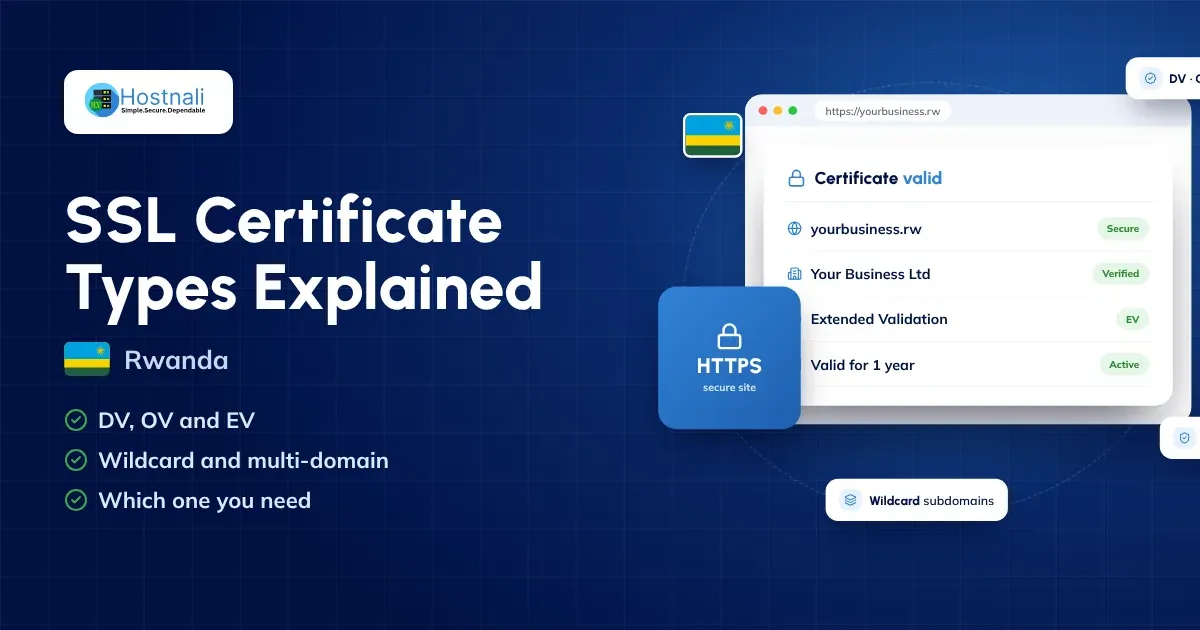
When you open a website and see HTTPS and a padlock in the address bar, that site is using a TLS certificate. Most people still call these SSL certificates, even though today’s websites use TLS rather than the older SSL protocol.
For businesses in Rwanda, picking the right SSL certificate is an important part of keeping a website secure. Whether you run a small business site, a WordPress blog, an online shop, a school portal, an NGO website, a company website or a web application, it should be served over HTTPS.
There is more than one kind of SSL/TLS certificate, though. You may have come across DV, OV, EV, wildcard and multi-domain certificates and wondered which one you actually need.
The good news: most website owners do not need the most expensive certificate on the market.
For many sites, a correctly configured Domain Validated (DV) certificate does the job.
This guide walks through the main SSL certificate types and helps you choose the right one for your website in Rwanda in 2026.
What Is an SSL Certificate?
An SSL certificate is a digital certificate that creates an encrypted connection between a visitor’s browser and your website.
Strictly speaking, modern certificates are used with TLS (Transport Layer Security), the protocol that replaced SSL. “SSL certificate” is simply the name that stuck.
When HTTPS is set up properly, the information travelling between the visitor and your website is protected from being easily intercepted.
That matters most when visitors:
- Sign in to an account
- Fill in contact or enquiry forms
- Register for an account
- Type in personal details
- Pay for something
- Shop in an online store
- Use private dashboards or student portals
- Upload documents or other sensitive files
A certificate also confirms that the website controls its domain and, for some types, which organisation stands behind it.
Why Does Your Website Need HTTPS?
HTTPS is the baseline for any modern website.
Without it, browsers display “Not secure” warnings and visitors feel uneasy about sending you anything through your site.
Google also recommends HTTPS for the security of websites and their users, and its systems generally prefer the HTTPS version of a page when deciding which URL to show in search.
For a Rwandan business, HTTPS helps with:
- Stronger website security
- Customer confidence
- Safer login forms
- Safer contact forms
- Secure connections for online shops
- Protection of data in transit
- A more professional image
- A sound technical foundation
It also supports your duties under Law No. 058/2021 of 13/10/2021 relating to the protection of personal data and privacy, which expects organisations to keep the personal data they collect secure.
That said, an SSL certificate does not make your entire website secure by itself. You still need strong passwords, software updates, backups, malware protection and careful administration.
Main SSL Certificate Types
The most common SSL/TLS certificate categories are:
- DV – Domain Validated
- OV – Organisation Validated
- EV – Extended Validation
- Wildcard SSL
- Multi-domain/SAN certificates
The thing to remember: DV, OV and EV describe how the applicant is checked, while wildcard and multi-domain describe which names the certificate protects.
1. DV SSL Certificate – Domain Validated
A Domain Validated (DV) certificate is the simplest and most widely used type of publicly trusted website certificate.
Before issuing it, the certificate authority checks that you control the domain.
For example, if you own:
example.rw
the certificate authority confirms you control that domain, usually through a DNS record, a file placed on the website or an email to an address at the domain.
DV certificates are suitable for:
- Personal websites
- Blogs
- Portfolios
- Small business websites
- Company websites
- WordPress websites
- Landing pages
- Information websites
- Small online shops
For most website owners in Rwanda, DV is the sensible choice.
Advantages of DV SSL
- Usually cheap or free
- Issued within minutes
- Easy to automate
- Fits most everyday websites
- Provides full HTTPS encryption
- Works in every modern browser
Free automated certificate authorities such as Let’s Encrypt issue TLS certificates at no cost.
Who should choose DV?
If you run an ordinary business website such as:
mybusiness.co.rw
and your main need is HTTPS encryption, a correctly set-up DV certificate is usually all you need.
2. OV SSL Certificate – Organisation Validated
Organisation Validated (OV) certificates add checks on the organisation that owns the domain.
The certificate authority verifies the domain and then confirms that the organisation exists and is registered, for example by checking business registration records.
OV suits organisations that want their verified identity tied to their certificate.
OV SSL can be suitable for:
- Established businesses
- Corporate websites
- Financial institutions and SACCOs
- Organisations with customer login areas
- Larger companies
- Websites where organisational identity matters
Keep in mind that OV does not mean stronger encryption.
A properly configured DV certificate and an OV certificate provide exactly the same TLS encryption.
What changes is the validation and identity assurance.
3. EV SSL Certificate – Extended Validation
Extended Validation (EV) certificates involve the most thorough checks on the organisation.
The certificate authority performs extra verification before it issues the certificate.
EV can be worth considering where additional identity assurance really matters, for instance at banks or large institutions.
There is, however, a widespread myth about EV.
EV does not mean “maximum encryption”
An EV certificate encrypts your website no better than a DV certificate does.
The only difference is how deeply the certificate authority checks the organisation.
Modern browsers have also dropped the old, eye-catching “green address bar” that used to make EV certificates stand out.
So don’t buy EV in the hope of better rankings or a dramatically more secure connection.
4. Wildcard SSL Certificate
A wildcard SSL certificate secures a domain together with all of its first-level subdomains.
For example, for:
example.co.rw
a wildcard certificate for:
*.example.co.rw
covers subdomains such as:
www.example.co.rw- shop.example.co.rw
- blog.example.co.rw
- mail.example.co.rw
A wildcard only covers one level of subdomains. It does not automatically protect deeper names such as:
store.shop.example.co.rw
unless that name is added separately.
Who needs a wildcard SSL?
Wildcard SSL makes sense when your website relies on several subdomains.
A business might, for example, run:
www.example.co.rw- shop.example.co.rw
- app.example.co.rw
- portal.example.co.rw
Rather than handling a certificate for each subdomain, one wildcard certificate keeps it all simple.
5. Multi-Domain SSL Certificate
A multi-domain certificate, also called a SAN certificate, protects several domain names or hostnames with a single certificate.
For example, one company might use one certificate for:
- example.rw
- example.co.rw
- example.com
- shop.example.com
How many names you can include depends on the product.
Multi-domain certificates are useful for:
- Businesses running several domains
- Companies with several brands
- Organisations looking after related websites
- Businesses merging or moving websites
- Larger groups with many web properties
If you only own one website, you probably don’t need a multi-domain certificate.
SSL Certificate Types Compared
| Certificate Type | Main Purpose | Best For | Typical Complexity |
|---|---|---|---|
| DV | Domain validation | Blogs, WordPress, SMEs, normal websites | Low |
| OV | Organisation validation | Established businesses and organisations | Medium |
| EV | Extended organisation validation | Organisations needing extra identity assurance | Higher |
| Wildcard | One domain + first-level subdomains | Businesses using many subdomains | Medium |
| Multi-domain/SAN | Several hostnames/domains | Organisations managing several domains | Medium/High |
Wildcard and multi-domain are not alternatives to DV, OV or EV. A single certificate can combine them, such as an OV wildcard certificate.
Which SSL Certificate Does a Small Rwandan Business Need?
For most small businesses in Rwanda, the answer is straightforward:
Start with a standard DV certificate.
If you have a website such as:
mybusiness.co.rw
with pages like:
- Home
- About
- Services
- Contact
- Blog
- Enquiry forms
you don’t need an expensive EV certificate.
A correctly installed DV certificate gives the site HTTPS.
Your bigger priorities should be:
- A correct HTTPS set-up
- Automatic renewal
- Secure hosting
- Regular backups
- Strong administrator passwords
- WordPress updates
- Malware protection
- Secure payment processing
- Reliable hosting
What SSL Certificate Does a WordPress Website Need?
Most WordPress websites can run on a standard DV certificate.
That includes:
- Business websites
- Blogs
- Personal portfolios
- NGO websites
- School websites
- Service websites
- Company websites
- Small online shops
If your host includes free SSL, there is no need to buy a separate certificate.
Hostnali includes free SSL certificates with every hosting plan, installed and renewed automatically.
What counts is that the certificate is installed, valid and configured properly.
What SSL Certificate Does an Ecommerce Website Need?
An online shop needs HTTPS because customers:
- Sign in to accounts
- Enter personal details
- Add products to their basket
- Fill in checkout forms
- Use payment pages
- Share delivery addresses and phone numbers
For most online shops, a correctly configured DV certificate provides the TLS protection the connection needs.
Running a shop does not, on its own, mean you need EV.
Remember, though, that SSL is only one piece of shop security.
You should also look at:
- Secure payment providers
- WordPress security
- WooCommerce updates
- Strong administrator passwords
- Secure hosting
- Malware scanning
- Backups
- Who can access the dashboard
- Data protection, including how you store customer details
- Fraud prevention
Do You Need Wildcard SSL for Your Website?
Start by counting the subdomains you use.
For example:
www.example.co.rw
shop.example.co.rw
portal.example.co.rw
app.example.co.rw
If you have many first-level subdomains, a wildcard certificate makes management easier.
If you only run:
www.example.co.rw
you don’t need a wildcard. On Hostnali hosting, the free certificates already cover the subdomains you create in cPanel.
Is Free SSL Safe?
Yes. A free SSL/TLS certificate is entirely suitable for a great many websites.
What matters is not the price, but whether the certificate is:
- Issued by a trusted certificate authority
- Installed correctly
- Valid
- Renewed on time
- Configured correctly
- Used across the entire website
Let’s Encrypt, for example, issues free automated TLS certificates, and many hosts include free SSL in their plans.
Free does not mean insecure.
Free SSL vs Paid SSL
A question Rwandan website owners often ask is:
“Should I pay for SSL or use free SSL?”
For many websites, free SSL is enough. Our guide to free SSL certificates in Rwanda covers this in more depth.
Free SSL suits:
- Blogs
- Small businesses
- WordPress websites
- Portfolios
- Information websites
- Small online shops
- Personal websites
Paid certificates help when you need:
- Organisation validation (OV) or extended validation (EV)
- A warranty from the certificate authority
- Central certificate management for a larger organisation
- Particular wildcard or multi-domain products
- A certificate for a server or service outside your hosting account
Hostnali sells DV, OV and EV SSL certificates for websites that need them.
Don’t buy a certificate because you assume a paid one encrypts better. It doesn’t.
Does SSL Improve SEO?
HTTPS is part of good modern SEO, but SSL is not a magic ranking switch.
Google recommends HTTPS, and its systems generally prefer the HTTPS version of a page when choosing which URL to index.
Installing a certificate, however, won’t lift a website from page 20 to page 1.
Your site still needs:
- Useful content
- Sensible keyword targeting
- Technical SEO
- Fast loading
- Mobile usability
- Quality backlinks
- Good internal linking
- Clean URLs
- A good user experience
Treat HTTPS as part of your website’s foundation, not a shortcut to rankings.
SSL Does Not Protect You From Everything
One of the most common misunderstandings is that SSL makes a website fully secure.
It doesn’t.
SSL/TLS protects data while it moves between the browser and the server.
Your website can still be compromised through:
- Outdated WordPress
- Vulnerable plugins
- Weak passwords
- Stolen administrator accounts
- Malware
- Poor server configuration
- Insecure themes
- Compromised hosting accounts
- SQL injection
- Weak access control
A site can carry a perfectly valid certificate and still contain malicious code.
That is why website security needs several layers. Read our guide on how to secure your website from hackers.
SSL Certificate Expiry
Every SSL/TLS certificate is valid for a set period and has to be renewed before it runs out.
If it expires, visitors see a browser security warning instead of your website.
That is why automation is essential.
Certificate lifetimes are also shrinking. The industry’s maximum validity for public TLS certificates was cut to about 200 days in 2026, with further cuts planned over the next few years.
Automatic issuing and renewal therefore matter more each year. On Hostnali hosting, free certificates renew automatically.
How to Check if Your Website Has SSL
Checking takes about a minute.
Step 1: Open your website
Type your domain into your browser.
For example:
https://example.rw
Step 2: Check the address
Your website should be using:
HTTPS://
and not:
HTTP://
Step 3: Check the browser’s security information
Click the site information icon beside the address to view the connection details.
Step 4: Check every version of your website
Test:
http://example.rwhttp://www.example.rwhttps://example.rwhttps://www.example.rw
All four should land on your preferred HTTPS version.
Common SSL Problems
Even with SSL installed, you can still run into issues.
1. Mixed Content
The page loads over HTTPS, but some images, scripts or files still load over HTTP.
That causes mixed-content warnings.
Solution: change those URLs to HTTPS and check your WordPress settings, theme and plugins.
2. Certificate Expired
The certificate’s validity period has ended.
Solution: renew or reinstall the certificate and turn on automatic renewal.
3. Wrong Domain
The certificate doesn’t cover the name the visitor is using.
For instance, it may cover:
example.rw
but not the www version or a subdomain.
Solution: check which names the certificate includes and how the server is configured.
4. HTTPS Redirect Loops
The site keeps sending visitors back and forth between HTTP and HTTPS.
Solution: check:
- WordPress URL settings
.htaccess- Server redirects
- CDN settings
- SSL plugins
- Reverse proxy settings
5. SSL Works but the Website Shows Errors
Sometimes the certificate is fine and something else is causing the trouble.
Check:
- DNS
- Hosting configuration
- CDN settings
- WordPress URL
- Server redirects
- Firewall rules
How to Choose an SSL Certificate in Rwanda
Before buying a certificate, work through these questions.
1. How many domains do I need to protect?
One domain needs only a standard certificate.
Several domains may call for a multi-domain/SAN certificate.
2. Do I use several subdomains?
If so, consider wildcard SSL.
3. Do I need organisation validation?
If your organisation’s identity must be verified, OV or EV may be the right fit.
4. Does my host already provide SSL?
Many hosts, Hostnali among them, include SSL at no extra cost.
5. Will the certificate renew automatically?
Automatic renewal removes the risk of a surprise expiry.
6. Does my website use HTTPS everywhere?
Installing the certificate is just the first step.
You also need the right redirects and settings.
Which SSL Certificate Should You Choose?
A quick guide:
Personal blog
DV SSL
Portfolio website
DV SSL
Small Rwandan business
DV SSL
Company website
DV SSL or OV SSL, depending on whether you want your organisation verified.
WordPress website
DV SSL
Small WooCommerce store
DV SSL
Website with many subdomains
Wildcard SSL
Company managing several domains
Multi-domain/SAN SSL
Organisation needing enhanced identity validation
OV or EV, depending on its requirements. Our answer on DV vs OV vs EV SSL sums up the difference.
Why Hosting Matters When Choosing SSL
Your certificate is only one part of the bigger picture.
A good host makes installing and renewing SSL effortless.
Look for hosting that includes:
- Free SSL
- Automatic SSL installation
- Automatic renewal
- HTTPS support
- Backups
- Malware protection
- Reliable servers
- Technical support
- cPanel or another easy control panel
Every Hostnali hosting plan includes free SSL certificates, along with cPanel, LiteSpeed servers, NVMe storage and daily backups.
That spares Rwandan businesses from buying and manually managing a separate certificate.
SSL Certificate Checklist for Rwandan Websites
Before you go live, make sure that:
- An SSL/TLS certificate is installed
- The website loads over HTTPS
- HTTP redirects to HTTPS
- The www and non-www versions are set up correctly
- The certificate covers the correct domain
- The certificate is valid
- Automatic renewal is switched on
- There are no mixed-content errors
- The WordPress URL uses HTTPS
- Images load over HTTPS
- Forms submit over HTTPS
- Payment pages use HTTPS
- Backups are running
- WordPress and plugins are up to date
- Administrator passwords are strong
Frequently Asked Questions
What is the best SSL certificate for a small business in Rwanda?
For most small businesses, a correctly configured DV certificate is enough.
Is free SSL good enough?
Yes. A trusted, properly configured free certificate suits most websites.
Do I need paid SSL for ecommerce?
Not necessarily. Online shops can use free DV certificates for HTTPS, provided they are set up properly. Shop security also depends on secure payments, a secure website and good hosting.
Are SSL and TLS the same thing?
Not technically. TLS is the modern successor to SSL, but “SSL certificate” is still the everyday name for website certificates.
Does SSL improve Google rankings?
HTTPS is an important technical and security factor, and Google usually prefers HTTPS pages. A certificate on its own won’t guarantee higher rankings, though.
Should I buy EV SSL for SEO?
No. Choose a certificate for its validation level, not as an SEO trick.
Do I need wildcard SSL?
Only if you have to protect many first-level subdomains of one domain.
Can one SSL certificate cover several domains?
Yes. Multi-domain/SAN certificates cover several named domains, depending on the product.
What happens if my SSL certificate expires?
Visitors get browser security warnings and HTTPS stops working normally. Automatic renewal is strongly recommended.
Final Thoughts
Choosing an SSL certificate doesn’t need to be complicated.
For most websites in Rwanda, a standard DV certificate is enough to provide HTTPS and protect the information passing between visitors and the site.
Businesses with lots of subdomains may benefit from wildcard SSL, and organisations with several domains may look at multi-domain certificates. OV and EV certificates matter mainly when verified organisational identity is important.
The aim isn’t to buy the priciest certificate.
Instead, make sure your website has:
Valid SSL + HTTPS + automatic renewal + secure hosting + regular updates + backups + good website security.
If you are starting a WordPress or business website in Rwanda, hosting that includes free SSL makes the whole set-up far easier.
Hostnali includes free SSL with every hosting plan and serves clients across Rwanda with 24/7 support by live chat and ticket.
A secure website is about more than the padlock. It’s about a set-up that protects your visitors, supports your business and gives customers confidence when they deal with you.