 RWF
 KES - Kenya
 UGX - Uganda
 TZS - Tanzania
 NGN - Nigeria
 ZAR - South Africa
 USD - Zimbabwe
 GHS - Ghana
 ETB - Ethiopia
 ZMW - Zambia
 USD - International

Kigali has no shortage of ambitious small businesses: coffee exporters, tour operators, tech start-ups, hardware traders. Most of them began with a spreadsheet for their books, and many are still using one long after it stopped fitting. Here is a practical way to judge whether yours has reached that point.
Start with what the books need to do
Before comparing tools, list the jobs. A Rwandan SME’s books usually need to:
- record every sale and purchase, with VAT at 18% where you are registered;
- show who owes the business and whom the business owes;
- match MTN MoMo, Airtel Money and bank receipts with invoices;
- produce the figures your accountant needs for RRA returns;
- give the owner a reliable monthly profit figure.
A spreadsheet can do each of these on its own. The trouble is doing them all together, every month, without errors.
Where Excel lets Rwandan businesses down
Receipts that arrive without a reference
A customer pays by MoMo and forgets to add the invoice number. In a workbook, the payment sits in a “to match” column until someone remembers the conversation. Multiply that by fifty payments and the column never empties.
Prices in more than one currency
Tour and coffee businesses often quote in US dollars and pay costs in Rwandan francs. Exchange differences end up as manual adjustments that nobody can later explain.
Receipting rules
Rwanda uses electronic billing machines (EBM) for receipts, administered by RRA. Which requirements apply depends on your registration, so confirm them with RRA or your accountant. A spreadsheet cannot help you meet them; a system that issues and records each sale can at least keep the evidence in order.
What accounting software brings
| Need | Spreadsheet | NaliSuite |
|---|---|---|
| Recording sales | Separate from invoicing | Posted when the invoice is issued |
| Mobile money receipts | Matched by memory | Imported and matched to invoices |
| Currencies | Manual adjustments | Invoices in the customer’s currency, books in francs |
| VAT | Worked out from totals | Per line, ready for the return |
| Where entries come from | Typed by hand | Posted from invoices, bills and payments |
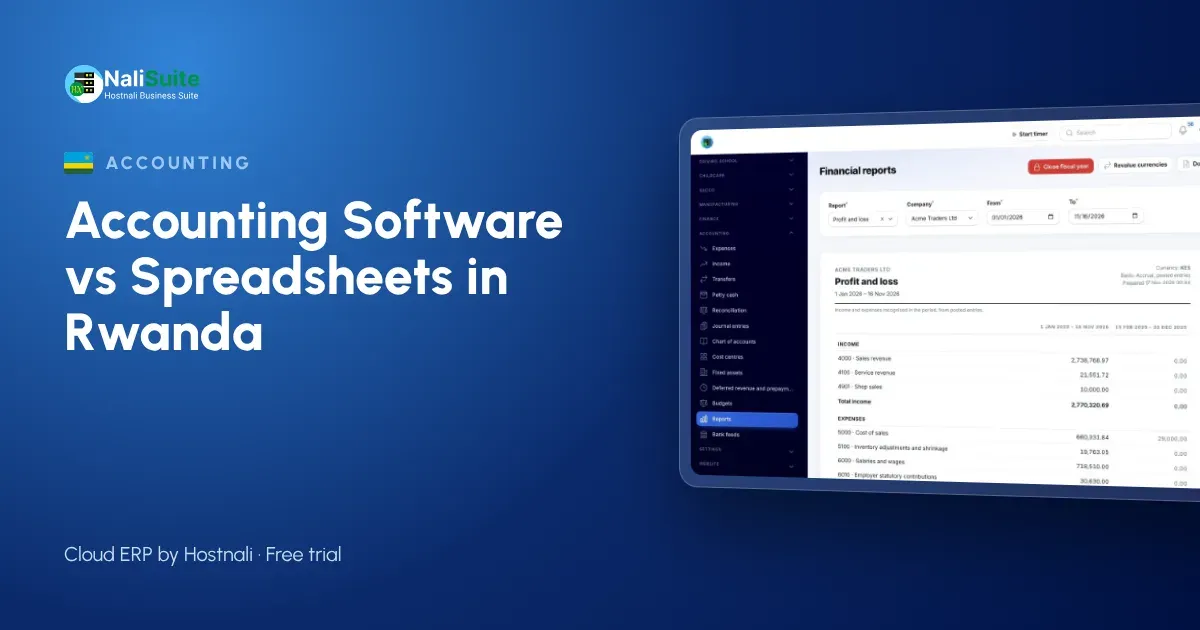
The NaliSuite Accounting app handles the ledger, and reconciliation brings in bank and mobile money statements. Customers can pay invoices by mobile money, card or bank, and the invoice updates when the money arrives.
When a spreadsheet is still fine
Honesty matters here. A sole trader with a few cash sales a week, no VAT registration and no staff can keep a clean spreadsheet for some time. The moment you register for VAT, hire people or extend credit, the case for software becomes strong.
How to change over
- Choose the first day of a month as your start date.
- Export customers, suppliers and products from your workbook.
- Import them and enter opening balances, including unpaid invoices.
- For the first month, record in both and compare totals weekly.
- Archive the workbook once the totals agree.
The switching guide covers moves from QuickBooks, Xero or Sage as well.
A second example: a Musanze tour operator
A tour operator near Volcanoes National Park sells packages in US dollars to foreign guests and pays guides, drivers and lodges in Rwandan francs. Its spreadsheet showed revenue by month but could not tie a tour’s income to its costs, because payments arrived weeks before the trip and bills arrived weeks after.
In software, each booking is an invoice in dollars. Deposits are recorded against it when they arrive, and every guide fee, vehicle cost and lodge bill is entered against the same booking. Once the tour is over, the owner sees what it earned. Seasonal planning got easier, because the busy months could now be compared tour by tour.
Local points to settle before switching
- Decide which bank and mobile money accounts the business will reconcile each week.
- Agree with your accountant how EBM receipts and invoices in the new system will be kept in line.
- Set up foreign-currency customers with their currency before you import open invoices.
- Pick a start date at the beginning of a VAT period.
Frequently asked questions
Can my accountant work in the same system?
Yes. Your accountant can be invited with access for your accountant to review entries and close the books.
Is my data safe in the cloud?
Data is kept off your laptop, so a lost or broken computer no longer means lost books.
Can I use it in more than one language?
Check the current language options on the NaliSuite site; the books themselves follow standard accounting rules whatever the interface language.
Can I record a deposit before the service is delivered?
Yes. Record it as a part payment on the invoice, and the balance stays open until the final payment.
Try NaliSuite
A free trial is the simplest way to test the difference with your own figures. Plans start at RWF 3,500 a month. See what each plan includes.