 RWF
 KES - Kenya
 UGX - Uganda
 TZS - Tanzania
 NGN - Nigeria
 ZAR - South Africa
 USD - Zimbabwe
 GHS - Ghana
 ETB - Ethiopia
 ZMW - Zambia
 USD - International

Rwanda’s small businesses benefit from fast digital payments, but a cashless till does not guarantee healthy cash flow. A Kigali agency can be paid instantly by individual clients and still wait months for corporate invoices. These tips help you manage the gap.
Know which customers drive your cash
Split your customers into two groups: those who pay at once (usually by MoMo or Airtel Money) and those on credit (usually companies and institutions). Track the credit group closely, because that is where cash gets stuck.
Set terms before you start the work
For credit customers, agree the price, the due date and any deposit in writing before work begins. Put the terms on the invoice and send it the day the work is delivered, with a mobile money pay link for smaller clients.
Bill milestones on long projects
Projects that run for months should be invoiced in stages, not at the end. Each milestone payment funds the next stage of work.
Keep overheads in proportion
Rent, salaries and subscriptions are paid whether or not customers pay. Before adding a fixed cost, check that your expected receipts cover it with room to spare.
Set aside RRA money
VAT and PAYE you collect belong to RRA. Keep them in a separate account until they are due.
Review every week
Check cash, debtors and creditors every week, and reconcile your receipts. Our guide to reconciling payments in Rwanda shows how.
Example: a Kigali events company
An events company in Kigali used to buy equipment and pay suppliers before clients paid anything. It now asks for a deposit on confirmation and the balance before the event day, with payment by MoMo or bank transfer. Supplier costs are covered before they are due, and the owner no longer funds events from personal savings.
A second example: a Rubavu coffee cooperative supplier
A supplier of processing equipment near Rubavu sells to coffee washing stations, which earn most of their income in the harvest season. The supplier offers payment plans timed to the harvest, collects deposits by MoMo before ordering equipment from abroad and keeps a reserve for the months between seasons. It no longer pays for imported equipment before customers have committed.
A checklist for Rwandan small businesses
- Deposits collected before ordering on behalf of a customer.
- Payment plans timed to customers’ income seasons.
- Milestone invoices on long projects.
- Weekly reconciliation of MoMo, Airtel Money and bank receipts.
- VAT and PAYE kept aside for RRA.
- Reserve built during strong months.
Getting started this month
Write down your three largest customers and how long each took to pay their last invoice. If any took more than the agreed terms, call them this week and agree how future invoices will be paid. Then look at your fixed costs and check that next month’s expected receipts cover them comfortably. Finally, set up a separate account for RRA money and a reserve account for the quiet months, and move something into each today, even a small amount.
How NaliSuite helps
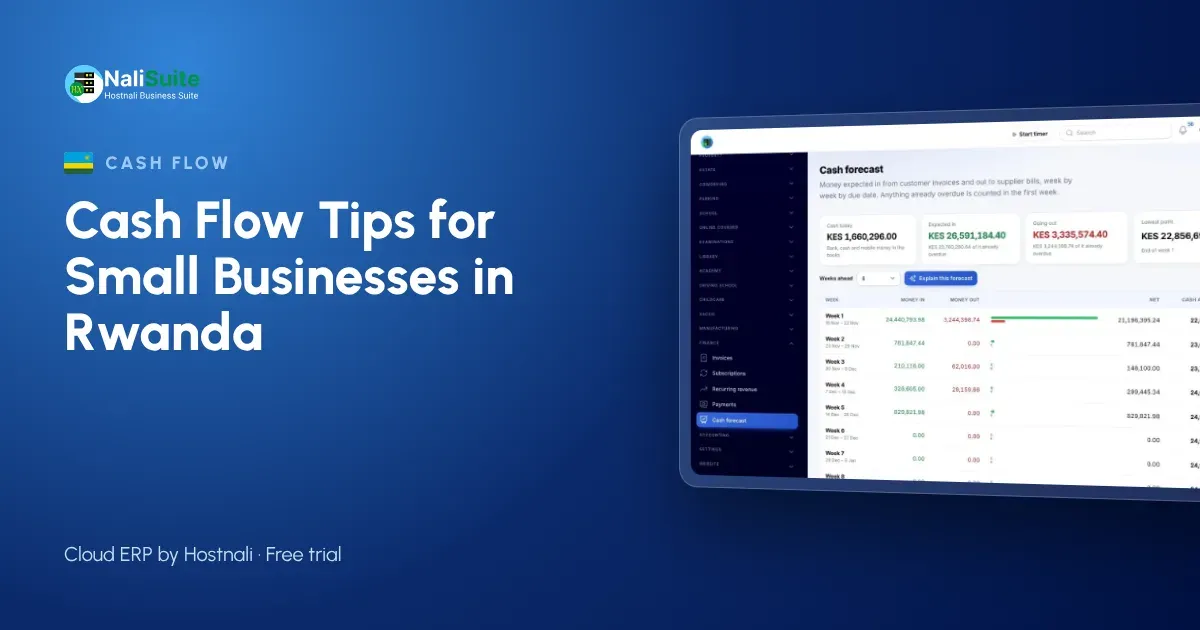
Invoicing sends invoices with mobile money pay links and reminders, Subscriptions bills retainers automatically and Accounting shows receivables and balances in one view, so your weekly review is quick and based on real numbers.
Frequently asked questions
Is it reasonable to ask companies for deposits?
For new clients and large projects, yes. Many businesses ask for part payment before starting.
How do I track milestone invoices?
Create an invoice for each stage in NaliSuite Invoicing and follow the open balance per project.
What is the simplest forecast?
A list of expected receipts and payments per week for the next three months.
How do I time payment plans for seasonal customers?
Set the larger instalments in the months when customers earn most, and smaller ones in between.
Should I order stock for a customer before they pay?
Only after a deposit large enough to cover what you would lose if the order is cancelled.
How do I handle a client who keeps extending deadlines?
Agree milestone dates in writing and invoice each milestone when it is delivered, not when the whole project ends.
Should I give discounts for early payment?
Only if your margins allow; a small discount can be cheaper than waiting months for payment.
What should my weekly review cover?
Cash in MoMo, Airtel Money and the bank, overdue invoices, and bills due in the next two weeks.
Can I share the forecast with my accountant?
Yes. Sharing it helps them advise on financing, tax payments and timing.
Is it worth moving retainer clients to monthly billing?
Usually yes. Monthly billing at the start of each month brings predictable cash, and clients often prefer smaller regular invoices to a large one at the end of a project. Set it up once and let the system issue each invoice.
Try NaliSuite
NaliSuite starts from RWF 3,500 a month. Compare the plans.