 RWF
 KES - Kenya
 UGX - Uganda
 TZS - Tanzania
 NGN - Nigeria
 ZAR - South Africa
 USD - Zimbabwe
 GHS - Ghana
 ETB - Ethiopia
 ZMW - Zambia
 USD - International

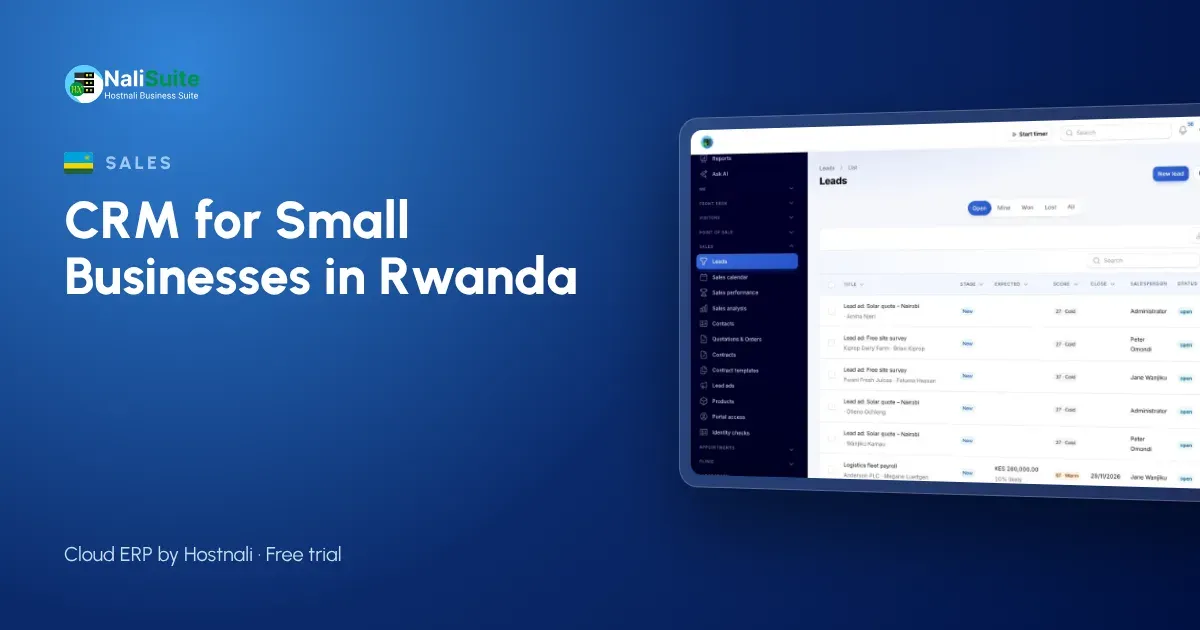
Rwanda’s businesses increasingly sell to clients who expect fast, professional follow-up. A CRM helps even a small team meet that standard.
This guide explains how to set up a CRM for a small business in Rwanda and make it part of daily work.
Why small businesses lose deals
Small businesses rarely lose customers in one dramatic moment. It happens slowly, one forgotten call at a time. Typical warning signs:
- You keep asking “did anyone call that customer back?”
- Quotations are written in documents and lost in email.
- Marketing spend goes up but nobody knows which channel works.
- Repeat customers are not contacted again after their first purchase.
At its core, a CRM is a list of leads and customers with a history and a next step attached to each one. Everything else, from pipelines to reports, builds on that.
Example: an IT services firm in Kigali
Think of an example IT services firm in Kigali selling network installations and support contracts to offices and schools. Leads come from referrals, the website and LinkedIn. Proposals were written in documents and emailed, and nobody tracked which ones were still open.
With a CRM, every opportunity has a stage, a value and a next step. Proposals are sent as quotations from the system, and the CRM shows which ones need a follow-up. Won deals turn into projects and invoices, and support contracts renew on time.
Five habits a CRM builds
1. One record per customer
Before you build a pipeline, sort out your customer list. Import it into NaliSuite Contacts, remove duplicates and add tags such as customer type or town. Every lead you create later links to these records.
2. Every lead in the pipeline
Map where your enquiries actually come from, then connect each source to the CRM. Forms on your website and lead ads on Facebook and Instagram can create leads on their own, and WhatsApp messages can be turned into leads with one tap. Phone calls and walk-ins are added by hand.
3. A next step for every lead
The fortune is in the follow-up. Give every lead a next step and a date. When the date arrives, the CRM reminds the owner of the lead. A simple rule works well: no lead without a next step.
4. Quotations from the same system
Use the same system for quotations as for leads. With NaliSuite Sales and Quotations, you send a quotation by email or WhatsApp, see when it is accepted, and convert it into an invoice in one step.
5. A weekly look at the numbers
| Report | Question it answers |
|---|---|
| Pipeline by stage | Where are deals getting stuck? |
| Wins by salesperson | Who needs support? |
| Leads by source | Where should next month’s budget go? |
| Lost deals | What can we fix? |
Quotations, invoices and MoMo
Accepted quotations become invoices with a pay link for MTN MoMo, Airtel Money or card. See mobile money payments in NaliSuite.
Making it part of how you work
Many Rwandan firms sell to organisations, where decisions involve several people and take weeks. Record every contact at the client, not only the main one, and log each meeting so the history is complete.
Set a value and an expected close date on each opportunity. The pipeline then shows what revenue is likely in the coming months, which helps with hiring and cash planning.
Review the pipeline weekly as a team, and update stages honestly. A pipeline full of deals that will never close is worse than a short, accurate one.
Choosing a CRM that fits
When you compare CRMs, look past the feature list. What matters for a small business is that it works on a phone, takes leads from the channels you already use, sends quotations and invoices from the same records, and is priced in your currency. A standalone CRM that does not talk to your invoicing means typing every won deal twice. Ask for a free trial and run real leads through it for two weeks before deciding.
Personal data in Rwanda
Rwanda’s Law No. 058/2021 on the protection of personal data and privacy, overseen by the National Cyber Security Authority (NCSA), applies to customer data in your CRM. Collect only what you need, keep it secure and use it only for the purposes you have explained.
A CRM with access by role keeps this data in one protected place.
Frequently asked questions
Can a CRM handle support contracts?
Yes. Contracts can be tracked as deals, and recurring billing through Subscriptions issues invoices every period.
Does Rwandan data law apply to my CRM?
Yes. Law No. 058/2021 covers personal data in a CRM. Keep it secure and use it only for the purposes you have explained.
Is a CRM only for sales teams?
No. Any business that follows up enquiries, such as schools, clinics and service firms, benefits from one.
How much time does a CRM take each day?
A few minutes per salesperson: logging calls and setting next steps. It saves far more time than it takes.
Try NaliSuite
Try the NaliSuite CRM free, with quotations and invoicing built in. Plans start at RWF 3,500 a month. View plans.