 RWF
 KES - Kenya
 UGX - Uganda
 TZS - Tanzania
 NGN - Nigeria
 ZAR - South Africa
 USD - Zimbabwe
 GHS - Ghana
 ETB - Ethiopia
 ZMW - Zambia
 USD - International

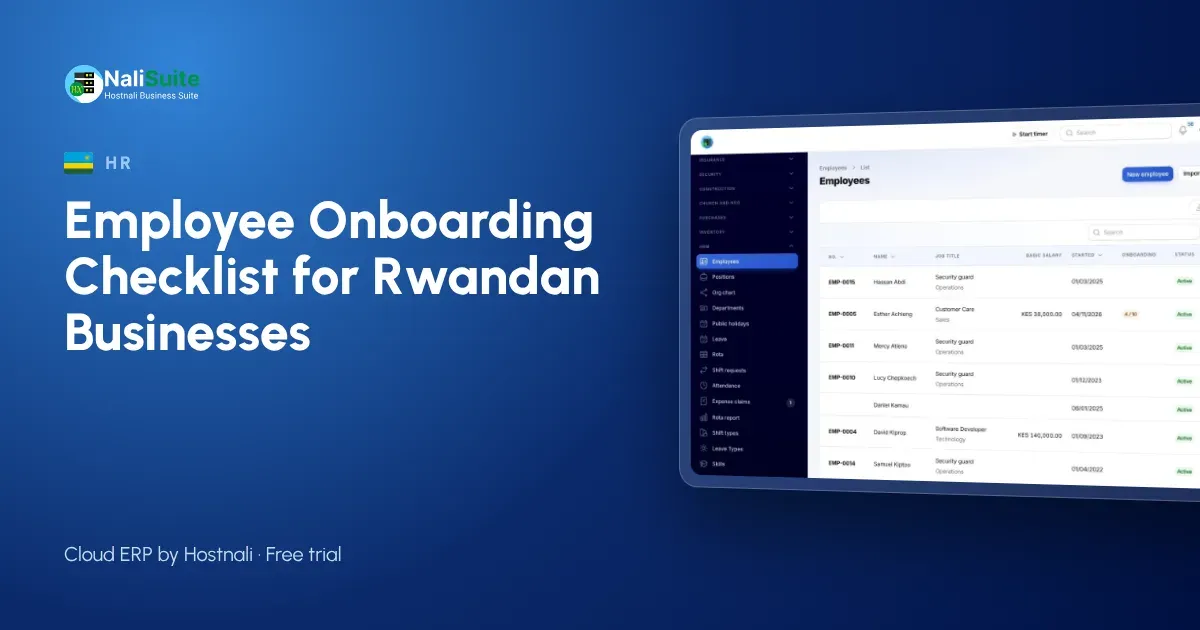
For a founder in Kigali, the first employees are a milestone. They are also the moment the business takes on new duties: contracts, PAYE, RSSB, payslips and keeping staff records properly.
This guide is written for small teams taking on their first, second or tenth employee. It covers what to prepare, how to run the first weeks, and the Rwandan payroll items to set up, using a small software company in Kigali as the example.
Start with the basics you will reuse
When you hire your first person, you build the process every later hire will follow. Spend an hour on it now:
- A contract template reviewed by someone who knows Rwandan employment practice.
- A one-page welcome note: hours, how leave works, who approves what, how to report sickness.
- A records list: what you need from every new hire before their first salary.
- A payroll set-up that applies the right deductions automatically.
With those four in place, the next hire takes minutes to set up, not days.
What to collect from a new hire
- Signed contract
- National ID number
- RRA TIN
- RSSB number
- Bank account or MTN MoMo / Airtel Money number for salary
- Next of kin and an emergency contact
- Degree or professional certificates where the role depends on them
Add them to the employee’s record in the HR app and upload the scans to Documents. A small team has no HR office; the record is the HR office.
The first two weeks in a small team
In a team of five, everyone is busy and the new person can easily be left alone. A simple structure helps:
Day 1. Coffee with the founder, introductions, tools and accounts. Install the employee app on their phone.
Days 2–5. One clear starter task, small enough to finish this week. Daily 15-minute check-in.
Week 2. A second, larger piece of work. Meet the customers or partners they will deal with.
End of week 2. Ask: what was confusing, what would have helped? Write it into the welcome note.
Payroll set-up for Rwanda
Before the first payday, make sure payroll is right. For Rwanda, NaliSuite’s payroll covers:
| Item | Rate | Note |
|---|---|---|
| PAYE | 0% up to RWF 60,000 a month, then 10%, 20% and 30% | Bands at RWF 100,000 and RWF 200,000 |
| RSSB pension | Current RSSB rate | Employee and employer; the rate is rising by steps to 2030 |
| RSSB maternity leave | 0.3% employee, 0.3% employer | |
| Occupational hazards | 2% employer | |
| CBHI | 0.5% employee | Of net pay |
PAYE and RSSB contributions are due by the 15th of the following month. Because the pension rate is changing in steps, check current rules with the Rwanda Revenue Authority and RSSB before each change date, and update the rate in NaliSuite’s settings. The PAYE calculator helps you agree a gross salary that gives the take-home pay you discussed with the candidate.
Example: a Kigali software company’s first two developers
A three-founder software company in Kigali hired its first two developers after winning a government-funded project. The founders had paid themselves informally until then and had never run a payroll.
They created both developers in the HR app the week before they started. The onboarding checklist that started for each one covered contract, ID and TIN, RSSB registration, laptop, accounts and a first task. On the first payday, NaliSuite produced the payslips, the PAYE declaration figures and the RSSB contribution report, and salaries went out by bank transfer and MoMo. The developers check their payslips and leave balance with employee self-service.
Plan for growth from the start
Small teams grow in jumps: one contract won, three people hired. Build habits that scale. Give every task in onboarding an owner, even if the owner is a founder. Keep conversations about work in one place, such as a Team chat group, rather than scattered across personal phones. And when someone leaves, use the offboarding checklist the HR app starts automatically, so laptops come back and access is closed the same day.
Protect what you collect
Rwanda’s Law No. 058/2021 on the protection of personal data and privacy, overseen by the National Cyber Security Authority, applies to employee records. Ask only for what you need, keep it in one secure place and limit access. In NaliSuite, each user only sees what their role allows, which matters as soon as you have more than one manager.
Write it down once
The biggest gift you can give your future self is a written process. After each hire, spend ten minutes updating the welcome note and the records list with whatever you learned. By the fifth hire, onboarding will run without the founders, which is the point at which a small company starts to scale.
Frequently asked questions
Do I need payroll software for two employees?
Not strictly, but setting it up early means PAYE, RSSB and CBHI are worked out the same way every month and your records are ready when the team grows.
When are PAYE and RSSB due in Rwanda?
By the 15th of the month after the salary month.
Can I pay salaries by mobile money?
Yes. NaliSuite’s payroll produces bank and mobile money payout files.
Try NaliSuite
Rwandan founders can run HR, payroll and the staff app on one login, from RWF 3,500 a month after a free trial. See the plans.