 RWF
 KES - Kenya
 UGX - Uganda
 TZS - Tanzania
 NGN - Nigeria
 ZAR - South Africa
 USD - Zimbabwe
 GHS - Ghana
 ETB - Ethiopia
 ZMW - Zambia
 USD - International

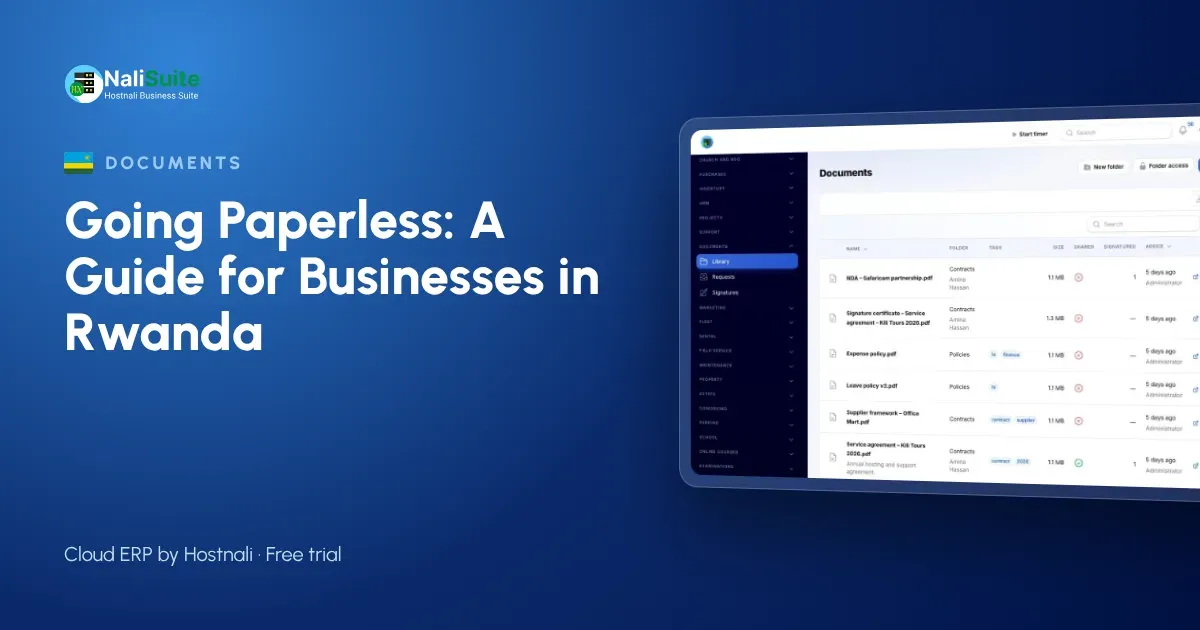
When businesses think about going paperless, they usually start with invoices. For a business with many staff, the bigger mountain of paper is often in HR: application forms, contracts, ID copies, attendance sheets, leave forms and payslips. Rwanda’s service companies, with large teams working at client sites, feel this most.
This guide starts where the paper is heaviest, with people, and then moves on to clients and suppliers. The example is a cleaning and facility services company in Kigali.
The example: a cleaning company in Kigali
The company, based in Gikondo, employs around 80 cleaners and supervisors who work at offices, apartment blocks and clinics across Kigali. The head office has four people. Before the change, every employee had a paper file, attendance was recorded on sheets at each site, and payslips were printed and handed out at the end of the month.
Part 1: people
Recruitment and onboarding
Applicants used to fill in paper forms at the office. Now NaliSuite HR offers a public careers page and an applicant pipeline, and successful candidates are hired straight into an employee record. Onboarding checklists start automatically when someone joins.
New staff upload their ID and certificates through a document request in NaliSuite Documents, rather than bringing photocopies that need filing.
Contracts signed online
Employment contracts are sent for e-signature. The new employee signs on a phone, and the company receives a stamped PDF with an audit certificate showing who signed, when and from where. The signed contract is filed in the employee’s folder automatically.
Each signature is recorded with that certificate, which supports its validity. Some documents may still need a particular form of signature or a witness, so check the rules for your type of document in Rwanda and keep originals where they are required.
Attendance at client sites
Attendance sheets at each site were the hardest paper to collect and the easiest to dispute. With employee self-service, staff check in from their phones with geofencing, so a check-in counts only at the right site, and late arrivals are flagged.
Leave and payslips
Staff apply for leave in the employee app, supervisors approve with a tap, and payslips are always available in the app. The end-of-month queue at the office for printed payslips has gone.
Part 2: clients
Service agreements
Agreements with offices and apartment managers are signed online, and the signed copies are shared with each client through the customer portal.
Site records
Each client has a folder with its agreement, site instructions and any reports, tagged by type and year. Every version is kept, so when a client updates its cleaning schedule, both versions are on file but only the latest is used.
Invoices
Monthly invoices are created in NaliSuite Invoicing and sent by email. Clients pay by MTN MoMo, Airtel Money, card or bank transfer, and mobile money payments are recorded against the invoice. Keep your invoices in line with what RRA requires of your business.
Part 3: suppliers
Cleaning chemicals, equipment and uniforms are ordered through NaliSuite Purchases, so every supplier bill has an order to match against. Receipts and supplier invoices that still arrive on paper are photographed, and with the Document AI add-on they are read and turned into bills or expenses for checking. Document AI uses the company’s own Anthropic API key.
Organising it all
The company uses one structure for everything:
- Staff: a folder per employee, with access limited to HR and managers.
- Clients: a folder per client and site.
- Suppliers: a folder per supplier and year.
- Company: policies and registration documents.
Tags such as contract, ID, agreement, invoice and policy make searching quick.
What changed
The head office stopped chasing attendance sheets from twenty sites, disputes about hours could be settled from check-in records, and new cleaners could be hired, signed and on site in days. The filing cabinet in the corner is now only for documents that must stay on paper.
Personal data
Staff files hold IDs, bank details and contracts, which are personal data protected under Rwanda’s Law No. 058/2021 relating to the protection of personal data and privacy, overseen by the National Cyber Security Authority. Digital files with access control are easier to protect than open cabinets, so give each person access only to the folders they need, and remove access when someone leaves.
Supervisors in the field
Site supervisors used to carry folders of attendance sheets and incident forms between buildings. Now they report problems from their phones, add notes to the client’s folder and see the latest site instructions wherever they are. When a client calls with a question, the head office in Gikondo can answer from the same records the supervisor sees on site.
Frequently asked questions
Do staff need smartphones for check-in?
Most staff use the employee app on their own phones. Attendance also supports web check-in and imports from biometric devices, so sites where staff do not carry smartphones can still record attendance without paper sheets.
Can new staff sign contracts on a phone?
Yes. E-signatures work on a phone, and the signed PDF is filed automatically.
Can clients download their agreements?
Yes. Share them through the customer portal or a secure link.
Try NaliSuite
HR, Documents, Invoicing and employee self-service are included in every NaliSuite plan, from RWF 3,500 a month. See the plans and move your staff files in during the free trial.