 RWF
 KES - Kenya
 UGX - Uganda
 TZS - Tanzania
 NGN - Nigeria
 ZAR - South Africa
 USD - Zimbabwe
 GHS - Ghana
 ETB - Ethiopia
 ZMW - Zambia
 USD - International

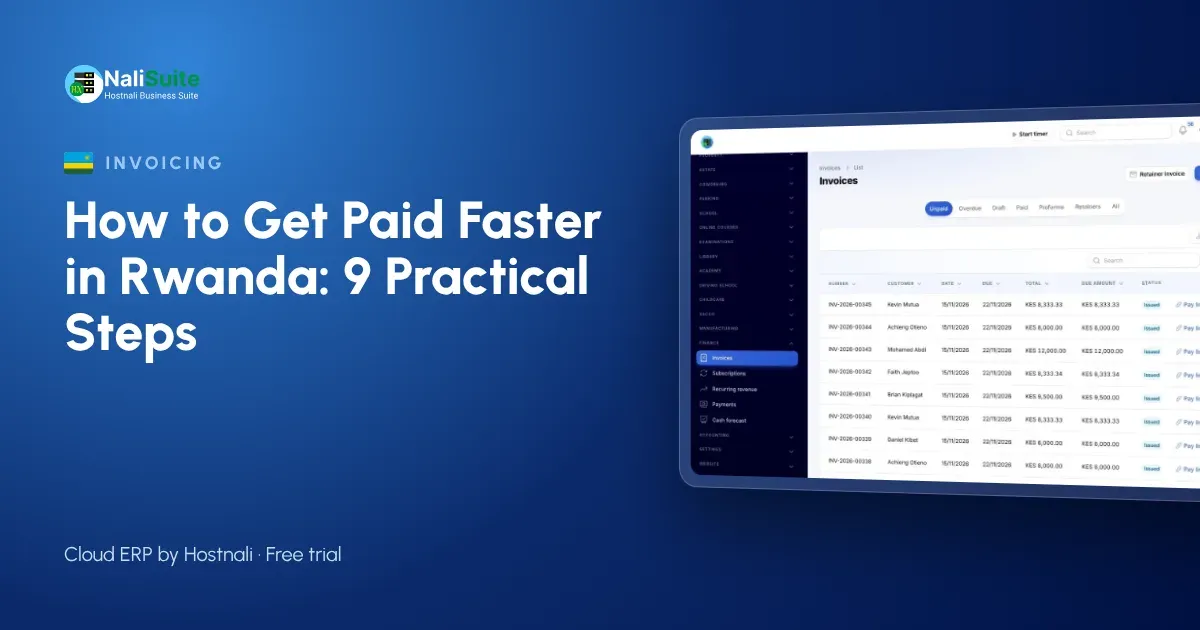
Cash in the bank pays salaries; invoices in a drawer do not. For a building supplies shop in Kigali, the gap between delivery and payment once stretched to six weeks, which meant borrowing to restock. This guide walks through what changed, step by step, so other businesses in Rwanda can shorten the same gap without chasing customers every day. The businesses in this guide are examples, but the problems will be familiar.
Do not let finished jobs wait for paperwork
Every day between finishing a job and sending the invoice is added to the end of your payment cycle. Uwase at the Kigali shop now sends the invoice from a phone before the van leaves the site. Make invoicing part of delivery, not an office task for later in the week. The Musanze hotel follows the same rule for deposits: the request goes out the day a booking is confirmed, not at the end of the week.
Put an MTN MoMo pay link on every invoice
A request to “send money to this number” is easy to postpone. A link that opens an MTN MoMo prompt on the customer’s phone is not. In NaliSuite Invoicing every invoice carries a link where customers in Rwanda pay by MTN MoMo or Airtel Money, card or bank transfer, and the invoice is marked paid when the money arrives. The payment goes to your own account; see mobile money payments in NaliSuite. For the Kigali shop, the share of invoices paid within a week rose sharply once paying took a single step.
Remove every reason to delay
The question “what is this invoice for?” can cost two weeks. Customers of a hotel in Musanze pay faster since every invoice includes:
- a due date, not just “payable on receipt”
- the order number the customer’s accounts team will look for
- your TIN, so their records are complete
- every way to pay, with the pay link at the top
- a named contact for questions
For occasional invoices, our free invoice generator covers the basics. After the change, the Kigali shop stopped getting calls from contractors and site engineers asking what an invoice was for.
Write the terms on the quotation
The Kigali shop lost several weeks a year to customers who “thought it was 60 days”. Now the quotation states the terms and the customer accepts it online, so the order and invoice carry the same terms with no retyping. Regular customers of the Musanze hotel now see the same terms on every quotation, so there is nothing to renegotiate when the invoice arrives.
Ask for a deposit on bookings and custom work
The Musanze hotel asks for a deposit before every booking, especially around the gorilla-trekking season. Send the deposit invoice with its pay link the moment the customer confirms; the balance invoice follows on delivery. Part payments are recorded against the invoice, so you always see what is still open. Around the gorilla-trekking season, the Musanze hotel asks for the deposit within two days of booking, so dates are not held for customers who never confirm.
Let reminders do the chasing
Calling customers about money is uncomfortable, so it gets put off. Automatic, polite reminders with the same pay link go out a few days before the due date, on the day and after it. Uwase at the Kigali shop says the after-due reminder alone brings in most late payments. The usual excuse at the Kigali shop, project payments that wait for sign-off, matters less when the reminder arrives with a link that takes ten seconds to use.
Statements turn many small debts into one payment
When a customer owes you on ten invoices, ten reminders annoy them. One statement with a total, sent at the start of the month, gets paid in one go. That is how the Kigali shop handles its regular contractors and site engineers. Uwase sends statements from the Kigali shop on the first working day of the month, when contractors and site engineers plan their payments.
A note for businesses in Rwanda
In Rwanda, mobile money is everywhere and customers expect to pay from their phones. Project customers are different: they pay after sign-off, so invoice in stages as each part of the job is approved.
Review what is owed once a week
Pick a day, check the list of overdue invoices and decide what happens to each: a reminder, a call or a stop on new orders. Fifteen minutes a week at the Kigali shop replaced a stressful end-of-month scramble. For the Kigali shop, the weekly check is now the moment to decide which of the contractors and site engineers get new deliveries.
Frequently asked questions
Which payment methods should I offer in Rwanda?
Offer what your customers already use: MTN MoMo or Airtel Money, card or bank transfer. The more familiar the option, the faster they pay.
Do pay links cost my customers anything?
That depends on your payment provider’s fees and how you set them up. The money goes to your own account, not through Hostnali.
When should I stop supplying a late payer?
Decide a rule in advance, such as pausing new orders when an account is a set number of days overdue, and apply it to everyone.
Can invoices go out automatically every month?
Yes. Subscriptions in NaliSuite raise and send recurring invoices with their pay link on the schedule you set.
Try NaliSuite
NaliSuite, also known as Hostnali Business Suite, handles invoices, payments and reminders for Rwandan businesses, from RWF 3,500 a month with a free trial. Compare the plans.