 RWF
 KES - Kenya
 UGX - Uganda
 TZS - Tanzania
 NGN - Nigeria
 ZAR - South Africa
 USD - Zimbabwe
 GHS - Ghana
 ETB - Ethiopia
 ZMW - Zambia
 USD - International

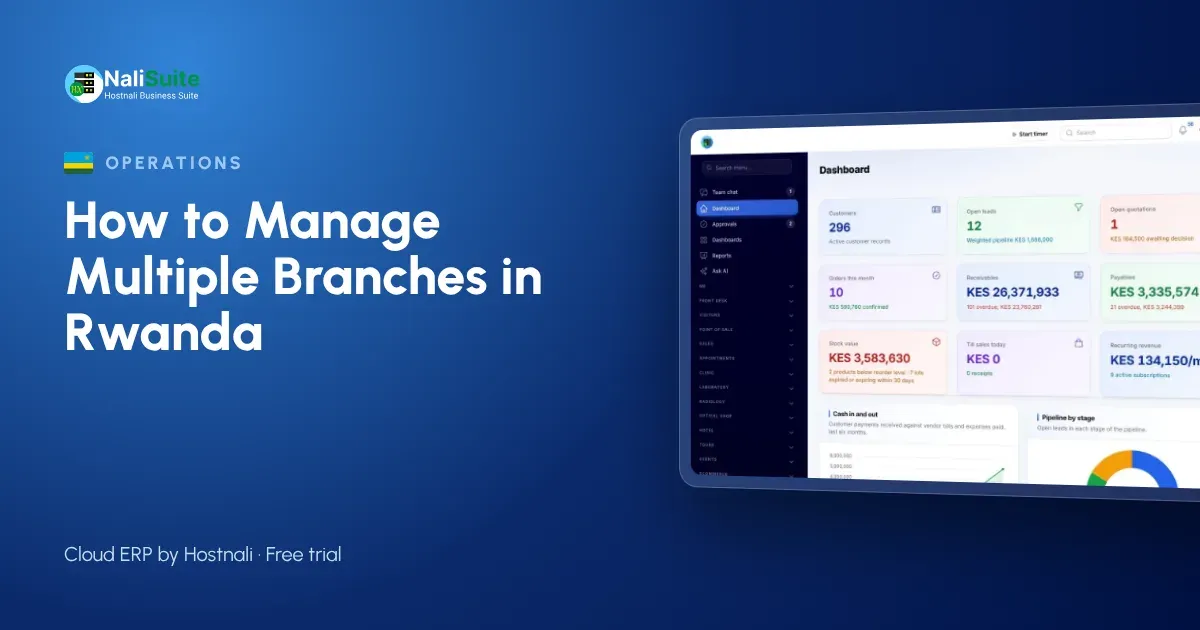
Rwanda is compact, which makes it tempting to run several branches the informal way: the owner drives between Kigali, Musanze and Huye and checks in person. That works for a while. As branches grow, stock, mobile money and cash need a system that tells the owner what is happening without the drive.
This guide covers the areas where Rwandan businesses with more than one branch most often lose control, and how to fix each one.
Take a cosmetics retailer with shops in Kigali city centre, Kimironko and Musanze. New stock arrives at the Kigali shop and is shared out, customers pay by mobile money and cash, and each shop keeps its own notebook. Bestsellers sell out in Musanze while boxes sit unopened in Kigali.
The building blocks of multi-branch control
- One product list for every branch. A product is created once and sold everywhere, with the same price list unless you choose otherwise.
- Stock per location. Inventory tracks each shop and warehouse separately, with lots and serial numbers where you need them.
- Transfers with a sender and a receiver. Stock leaving Musanze is added to Huye’s stock only when Huye confirms what arrived.
- A till per branch. The point of sale runs on a phone, tablet or laptop and keeps selling offline.
- Cost centres per branch. So the profit report reflects each branch’s own costs.
- One login per person. So every action has a name on it.
When a branch should be a separate company
Most branches are simply locations of one business: one set of books and one tax registration. A branch becomes a separate company when it is a separate legal entity, for example a subsidiary or a business in another country. NaliSuite keeps several companies under one login, each with its own books and taxes, as explained on the multi-company page.
A weekly branch routine
| When | Task |
|---|---|
| Daily | Close every till and record the cash count |
| Monday | Receive all transfers, including those to Rubavu |
| Midweek | Count the 20 fastest-moving products at each branch |
| Friday | Review branch sales and stock reports |
| Month end | Run profit and loss per branch |
Signs your branches need a system
- Branch managers in Musanze and Huye phone each other to find stock.
- The end-of-day MTN MoMo and cash totals rarely match the sales book.
- Stock counts differ from what you expected by more than a few items.
- You cannot say which branch is most profitable without a week of work.
- Customers get different prices at different branches.
Moving from notebooks to one system
Start with one branch, usually the main shop in Kigali, and run it on the new system for two weeks. Use that time to set up the product list, price list and till routine. Then add the other branches one by one, each with an opening stock count on the day it goes live. Within a month every branch records sales, stock and cash the same way, and the owner’s reports come from one place.
Train one person per branch properly rather than everyone a little. The supervisor in Musanze who knows the till, transfers and stock counts well becomes the person others ask, and problems in Huye or Rwamagana get solved on the spot instead of waiting for head office. Our team can help with the first imports and set-up.
Branches in Rwanda: local points
Rwandan branches often take most payments by mobile money. Matching each branch’s receipts to its sales every week, rather than at the end of the quarter, catches problems early. Keep all branches in one company if they trade under one TIN.
Because distances in Rwanda are short, it is tempting to move stock between branches informally in the owner’s car. Record those trips as transfers anyway. A five-minute entry keeps every branch’s stock accurate, and it means a manager in Huye can see what is available in Kigali before promising a customer.
Rwandan businesses that sell to government bodies, schools or NGOs often wait longer for payment than shops paid on the spot. Track those receivables per branch, send statements from the system each month and set payment reminders, so a branch that serves institutional customers is judged on what it actually collects, not only on what it sells.
Frequently asked questions
Can I move stock between branches quickly?
Yes. Record a transfer from one branch to another; the stock leaves one location and arrives at the other when it is received.
Can I compare branches side by side?
Yes. Reports show sales, stock and profit per branch or for all branches together.
How many branches can NaliSuite handle?
Every plan can run several branches; plans differ by users and storage. The Business and Enterprise plans suit larger teams, and Enterprise is made for groups and multi-company operations.
Try NaliSuite
NaliSuite runs inventory, point of sale, purchases and accounting for every branch in one cloud ERP, from RWF 3,500 a month. Compare plans on the plans page and start a free trial.