 RWF
 KES - Kenya
 UGX - Uganda
 TZS - Tanzania
 NGN - Nigeria
 ZAR - South Africa
 USD - Zimbabwe
 GHS - Ghana
 ETB - Ethiopia
 ZMW - Zambia
 USD - International

Rwandan customers, and the visitors who shop in Kigali, increasingly expect quality, clear prices and proper receipts. That is good news for small businesses that price thoughtfully: customers who trust you are willing to pay for what you offer. The challenge is to set prices that reflect that value while staying safely above your costs.
This guide takes a value-first approach, then checks it against the numbers.
Who is your customer, and what do they compare you to?
A bag of coffee from a Kigali roaster can be compared to supermarket coffee, to another roaster, or to a gift shop item for tourists. Each comparison supports a different price. Before you set one, answer three questions:
- Who buys this product? Local households, offices, hotels and restaurants, tourists, export buyers.
- What would they buy instead? A cheaper version, a competitor, or nothing at all.
- What is special about yours? Origin, freshness, packaging, delivery, service, the story behind it.
The answers tell you whether you should be a value, standard or premium option.
Check the cost floor
Value tells you how high you could go. Your costs tell you how low you can afford to go. For each product, total:
- raw materials or the supplier price,
- labour and production time,
- packaging and labels,
- transport from the supplier, or from Musanze, Huye or Rubavu to Kigali,
- the share of rent, wages, power, internet and your own pay,
- charges for receiving MTN MoMo, Airtel Money or card payments, if any,
- losses and waste.
If the value-based price is not comfortably above this floor, rethink the product: change the pack size, the supplier, or the way it is made.
Offer good, better, best
Tiers let customers choose without haggling:
| Tier | Example for a coffee roaster |
|---|---|
| Good | 250 g everyday blend |
| Better | Single-origin 250 g, roasted this week |
| Best | Gift box with two origins and a tasting card |
The middle tier is often the most popular, and the top tier makes it look like good value. Each tier should carry its own margin target.
Mind the difference between margin and markup
Margin is the profit as a share of the price; markup is profit as a share of cost. Adding 25% to a cost of 4,000 gives 5,000, but your margin is only 20%. To reach a 25% margin, divide 4,000 by 0.75 for a price of about 5,330.
Apply VAT correctly
If you are registered for VAT, the standard rate in Rwanda is 18%, collected for the Rwanda Revenue Authority. Calculate margins on prices before VAT. For consumers, show a VAT-inclusive price; for business customers, show VAT separately on the invoice. Check current requirements, including invoicing rules, with RRA. The free VAT calculator adds or removes VAT from any amount.
Discounts that make sense
Use discounts to win something specific:
- Hotels and offices placing regular orders: a contract price.
- Resellers: a wholesale price above a minimum order.
- Slow periods: a promotion with a fixed end date.
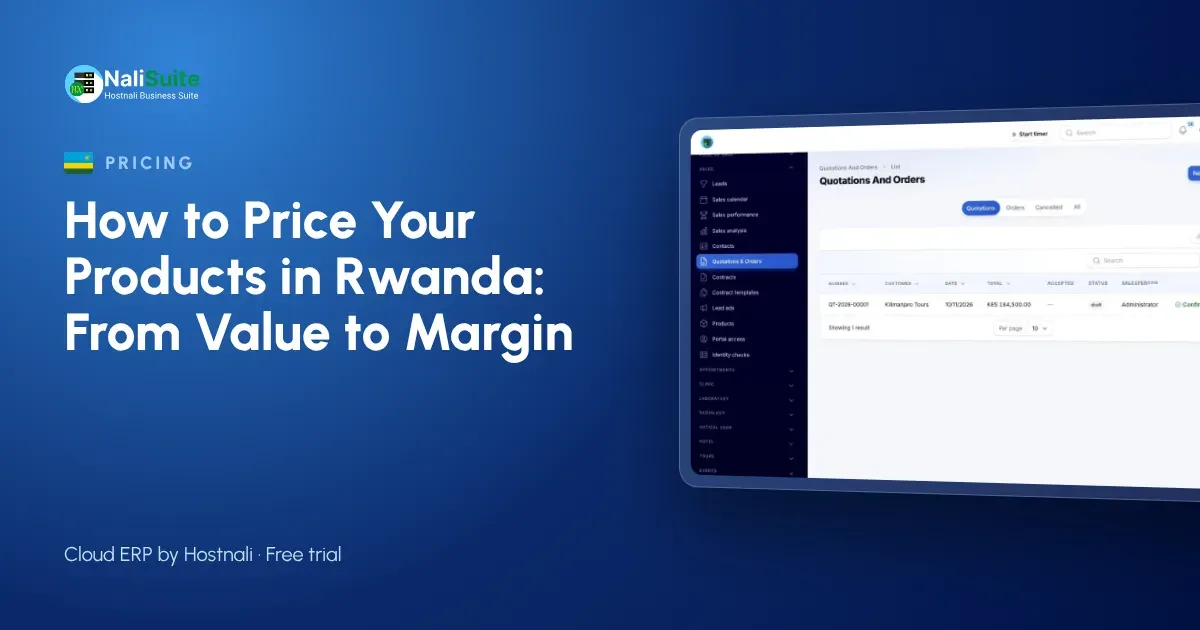
Keep these rules in the system, not in staff members’ heads. The NaliSuite sales app stores price lists by customer group, currency or quantity, and applies time-limited promotions automatically. Quotations for hotels and offices are built from the same lists and can be accepted online.
A worked example
A roaster in Kigali sells the “Better” single-origin bag. Using plain example numbers:
- Green coffee and roasting: 3,200.
- Bag, valve and label: 600.
- Share of overheads: 700.
- Full cost: 4,500.
The roaster targets a 40% margin on this premium tier: 4,500 ÷ 0.6 = 7,500 before VAT. Hotels on a monthly contract pay 6,800, still a margin of about a third.
Review and adjust
Costs change, and so does what customers will pay. Check margins every month. NaliSuite inventory tracks the cost of each product with freight added as a landed cost, and accounting reports gross margin by product. If a margin slips, you will see it in time to act.
Pricing services as well as products
Many Rwandan small businesses sell time rather than goods: tour guiding, design, repairs, consulting, cleaning. The same thinking applies. Work out what an hour or a day of your time really costs, including the hours you cannot bill – travel between clients in Kigali, quoting, admin and quiet weeks. Then add your margin. A designer who bills only twenty hours a week must price each of those hours to cover the full week. Fixed-price packages, such as a logo with three revisions, are easier for clients to compare and protect you from projects that never end.
Frequently asked questions
How do I price for tourists and locals?
Many businesses use one price and different products: smaller everyday packs for locals, gift packs for visitors. Charging different prices for the same item can damage trust.
Should I show prices in US dollars?
Most local customers expect Rwandan francs. If you sell to foreign buyers, keep a separate price list in their currency.
What is a good first margin to aim for?
Start from your costs and overheads; the margin must cover slow months and leave a profit. Then test with real customers.
Try NaliSuite
NaliSuite links your costs, price lists, quotations and till so your prices always cover your costs. Plans start at RWF 3,500 a month, shown in francs, with a free trial. See the plans.