 RWF
 KES - Kenya
 UGX - Uganda
 TZS - Tanzania
 NGN - Nigeria
 ZAR - South Africa
 USD - Zimbabwe
 GHS - Ghana
 ETB - Ethiopia
 ZMW - Zambia
 USD - International

Cooperatives are central to farming in Rwanda, from coffee washing stations in the south and west to dairy groups in the east and tea outgrowers in the hills. Members expect accurate weights, fair deductions and prompt payment. This guide explains how to keep those records straight, season after season.
A worked example: a coffee washing station in Huye
Consider a cooperative that runs a coffee washing station in Huye District. During the harvest, members deliver cherry every day; each delivery is weighed and the price for the day applies. Members may receive an end-of-season bonus once the coffee is sold. Recording each delivery against the member at the scale, with a text receipt to their phone, means the bonus can be calculated fairly in proportion to what each member delivered.
Weigh, grade and confirm each delivery
Members judge the cooperative at the scale. Weigh every delivery in front of the member, record the grade or quality check, and confirm the entry with a text message to the member’s phone before they leave.
The same record drives the payout, the stock received into the store and the figures you report to your buyer, so a delivery is only ever entered once.
Members first: a register you can rely on
Treat the member register as the cooperative’s most valuable document. Each entry needs the member number, full name, phone, payout details, route or centre, joining date and a contact person in the family.
Limit who can change payout details, and keep a note of every change and who made it. A changed phone number or bank account is the easiest way for money to go astray.
Payday: from deliveries to money in members’ hands
On payday the steps should be routine: close the period, check the totals against what your buyer paid, approve the payout list and pay members by MTN MoMo or Airtel Money.
Keep the approval with two people, such as the treasurer and the chair, so no single person can change the list and pay it.
Track what members owe before payday
Credit is where cooperatives lose money quietly. Every bag of fertiliser, sack of feed or cash advance given to a member should be recorded against them as it leaves the store, not reconstructed from memory at the end of the season.
Set a limit on credit per member, linked to what they usually deliver, so nobody falls so far behind that their payout disappears entirely.
Deductions members can understand
Deductions are the most common cause of complaints. List them clearly: what the item is, when it was taken and how much is being recovered this period.
If a member’s deductions are larger than their earnings for the month, carry the balance forward rather than paying them nothing without explanation, and tell them before payday.
Paying members by MTN MoMo or Airtel Money
Mobile money is the easiest way to pay members in Rwanda. Confirm each member’s MTN MoMo or Airtel Money number at registration, and check it again before the first payout of the season.
Keep the cooperative’s own savings and loan records together with deliveries, so that any loan repayment taken from a payout is visible on the member’s statement and in the books.
Doing it in NaliSuite
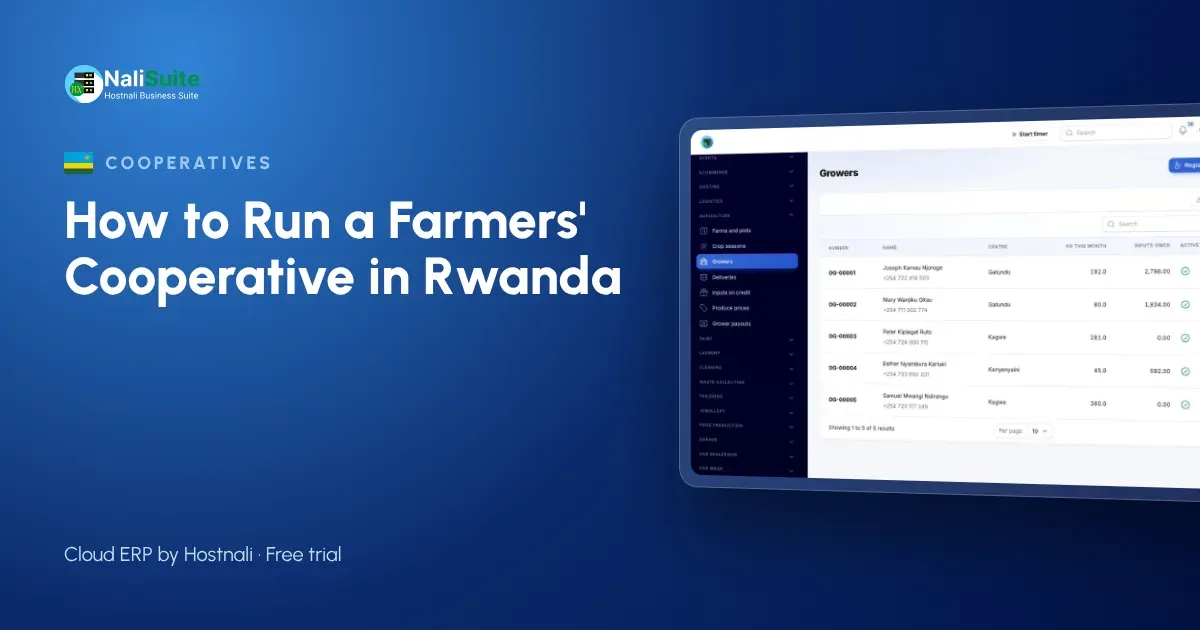
You do not need to build this from scratch. In NaliSuite, the Agriculture and Outgrowers add-on registers the growers who supply you, records weighed collections priced by grade with a text receipt, and settles inputs given on credit in each payout. Dairy groups use the Dairy Cooperative Milk Collection add-on for routes, intake with density rejection, store credit and monthly payouts.
The SACCO and Microfinance add-on adds member savings, share capital and loans, and members can see statements in a portal. The store’s stock lives in Inventory, the books in Accounting, and the farms and cooperatives page shows how they fit together.
Show members their numbers
Trust grows when members can check the figures themselves. A short statement with deliveries, price, deductions and payout, sent after every payday, answers most questions before they are asked.
Keep reports for the committee too: deliveries by route or centre, credit outstanding, and payouts per period. They show where problems are building before members notice.
A note on member data: the register holds names, phone numbers and payment details, so treat it carefully. In Rwanda that means following Law No. 058/2021 on the protection of personal data and privacy, overseen by the National Cyber Security Authority. Limit who can see member records and never share lists outside the cooperative.
Frequently asked questions
Can we calculate an end-of-season bonus per member?
Yes. Because every delivery is recorded against the member, a bonus can be shared in proportion to what each member delivered.
Can payouts go to mobile money?
Yes. Payouts can be sent to MTN MoMo or Airtel Money numbers and are recorded on each member’s statement.
Do the add-ons cost extra?
Yes. The cooperative add-ons are added to any NaliSuite plan and billed with the subscription; plans start from RWF 3,500 a month.
Can we import our existing member list?
Yes. A member list kept in Excel can be imported in one go, with names, phones and payout details, so you do not retype anyone.
Try NaliSuite
Pick one route or collection centre, set it up during a free trial and run it alongside your current books for a month. View plans and prices.