 RWF
 KES - Kenya
 UGX - Uganda
 TZS - Tanzania
 NGN - Nigeria
 ZAR - South Africa
 USD - Zimbabwe
 GHS - Ghana
 ETB - Ethiopia
 ZMW - Zambia
 USD - International

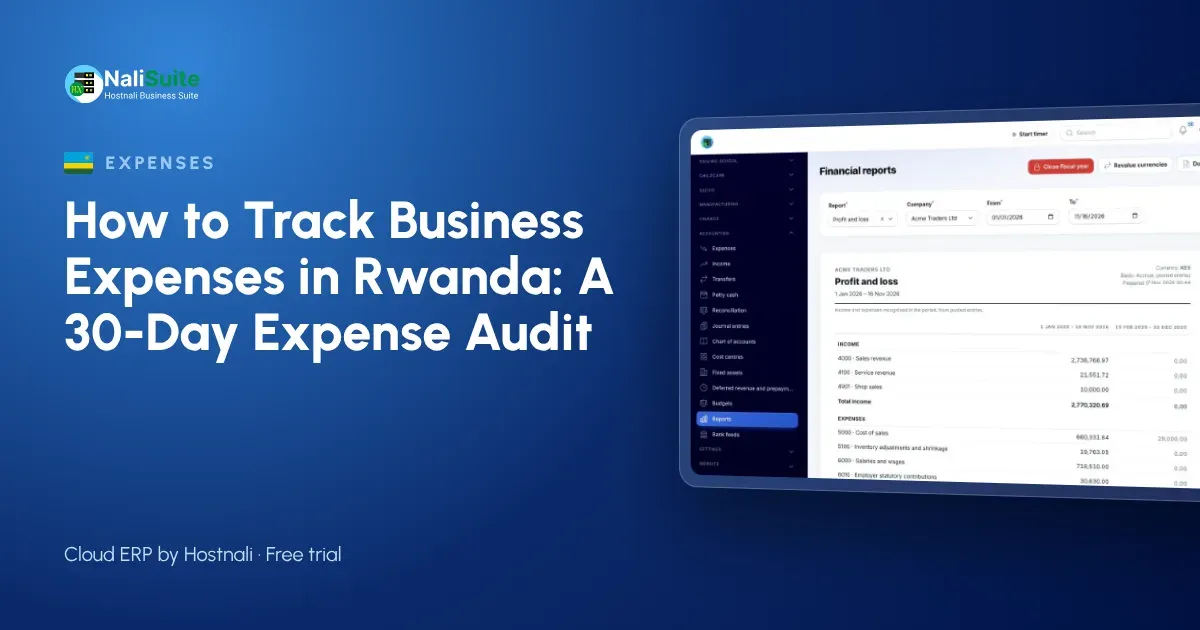
If you have never tracked your business expenses carefully, the best way to start is not with a system but with an experiment. For thirty days, record every franc that leaves the business. At the end, you will know where your money goes, which costs surprised you and what kind of tracking your business really needs.
This guide walks you through a 30-day expense audit for a Rwandan small business, then shows how to turn what you learn into a routine.
Before you start
You need three things:
- A place to record expenses – a notebook, a spreadsheet or your accounting software.
- A short list of categories – you can adjust it after the audit.
- An agreement with your team that every expense is recorded on the day it happens.
Suggested starting categories:
| Category | Examples |
|---|---|
| Stock and materials | Goods for resale, raw materials |
| Transport | Moto fares, fuel, bus tickets, deliveries |
| Premises | Rent, repairs, cleaning, security |
| Utilities | Electricity, water, internet |
| Staff | Wages, casual labour, lunches |
| Communication | Airtime, data bundles |
| MoMo and bank charges | Transfer and withdrawal fees |
| Marketing | Adverts, printing, sponsored posts |
| Fees and licences | Professional fees, permits |
| Equipment | Tools, phones, computers |
Days 1–30: record everything
For every expense, write the date, amount, category, who spent it, what for, and how it was paid: MTN MoMo, Airtel Money, bank, card or cash. Keep every receipt and photograph it.
In Rwanda, ask suppliers for an EBM receipt from their Electronic Billing Machine whenever you buy from a VAT-registered business. It is the receipt RRA expects to see if you claim input VAT on that purchase. Check the current rules with RRA for your situation.
For payments with no receipt, such as a moto fare, write a short voucher. Record mobile money charges too: they are deducted automatically and easy to forget.
Day 31: look at the results
Total each category for the month. Then ask:
- What were the three biggest categories? Are they what you expected?
- Which costs surprised you? Often transport, communication or charges.
- What could not be explained? Payments on the statement with no record behind them.
- Who spent the most, and on what?
Many owners find that one or two categories are much larger than they believed, and that a handful of payments cannot be traced. Those are the places to focus.
Turning the audit into a routine
Once you know your spending pattern, build a lighter routine you can keep up all year.
Approvals
Decide who may spend how much without asking. In NaliSuite purchases, you set approval rules by amount for purchase orders, bills and expenses, and purchases above the limit wait for the right person.
Expense claims from staff
Staff who buy things for the business should be able to claim quickly. NaliSuite employee self-service lets them photograph the receipt and submit a claim from their phones, and managers approve with a tap.
Less typing
The Document AI add-on reads supplier invoices and receipt photos – supplier, invoice number, dates, lines, VAT and totals – and prepares a draft bill or an expense for you to check before saving. Your business supplies its own Anthropic API key for it.
Monthly reconciliation
Each month, match every payment on your bank, MTN MoMo and Airtel Money statements to a recorded expense. NaliSuite accounting imports statements or connects bank feeds and suggests matches, and bank and mobile money reconciliation shows what remains unmatched.
What a sample audit revealed
A sample tour and transport company in Kigali ran the 30-day audit. It found that:
- communication costs were spread over seven SIM cards, three of them rarely used,
- vehicle repairs were paid in cash to different mechanics with no records,
- mobile money charges were higher than expected, because many small supplier payments were sent one by one.
The company cancelled the unused lines, chose two trusted garages with written job cards, and began batching supplier payments weekly. The next month’s expenses were noticeably lower, without cutting anything the business needed.
Keep it simple
The goal is not perfect paperwork. It is a clear, honest view of where money goes, so you can make better decisions. Record on the day, review weekly, reconcile monthly and repeat the full audit once a year.
Separate business and personal money
Use a business MoMo line and bank account only for the business, and pay yourself a fixed amount from them. Personal spending then stays out of the records.
Frequently asked questions
Why is the EBM receipt important?
For VAT-registered businesses, it is the receipt that supports an input VAT claim. Ask for it whenever you buy from a VAT-registered supplier.
Should I include my own spending in the audit?
Yes, if you spend on behalf of the business. Keep personal spending out of the business records entirely.
What if my staff forget to record expenses?
Make it as quick as possible, check weekly and do not reimburse claims without a receipt or voucher.
Try NaliSuite
NaliSuite keeps expenses, claims, approvals and MoMo reconciliation together, so every franc is accounted for. Plans start at RWF 3,500 a month, shown in francs, with a free trial. Compare the plans.