 RWF
 KES - Kenya
 UGX - Uganda
 TZS - Tanzania
 NGN - Nigeria
 ZAR - South Africa
 USD - Zimbabwe
 GHS - Ghana
 ETB - Ethiopia
 ZMW - Zambia
 USD - International

Kigali’s growing conference and events trade, its construction sites and its many service firms all run on quotations. A customer asks for a price, several suppliers respond, and the one that answers clearly and quickly is usually chosen.
This guide takes you through the quotation process step by step, using an example events company in Kigali, and shows how to turn an accepted quote into payment.
Step 1: Take the request properly
An events company receives a request: “Please quote for a workshop for 60 people, one day, with lunch and two tea breaks.”
Before quoting, the company asks:
- What date, and where? Do you need us to provide the venue?
- Do you need a projector, sound system or interpretation?
- Any dietary requirements?
- Who will approve the quote, and by when?
The answers change the price completely. A quote based on guesses usually has to be redone.
Step 2: Build the price
For each part of the job, work out the cost and add your margin:
- venue hire or room set-up;
- catering per person;
- equipment and a technician;
- transport for equipment and staff;
- your own staff time on the day.
Price per unit where you can (per person, per day, per item). It makes the quote easier to adjust if numbers change.
Step 3: Write the quotation
Include these elements, in this order:
- Header: business name, address, phone, email and TIN; your VAT registration if you have one.
- Customer: organisation name, contact person and their reference.
- Quote number, date and validity: for example, valid for 21 days.
- Scope: “One-day workshop for 60 participants on [date], including lunch, two tea breaks, projector and sound system.”
- Lines: each item with quantity, unit price and total, in Rwandan francs.
- VAT: if you are registered, VAT at 18% on a separate line and the total including VAT.
- Payment terms: “50% deposit to confirm the booking, balance within 7 days of the event, by MTN MoMo, Airtel Money or bank transfer.”
- Conditions: cancellation, changes in numbers and what is excluded.
- Acceptance: signature or an online acceptance link.
The free VAT calculator helps when a client wants a VAT-inclusive figure. Check RRA’s current rules for the invoice that follows, including electronic billing.
Step 4: Present options
Give the client a choice. For the workshop, a standard menu and an upgraded menu, shown as optional lines, lets them pick without asking for another quote. Clients often choose the middle option when they see two.
Step 5: Send it the same day
Speed matters. Send the quotation as a PDF or link, by email or WhatsApp, on the day you get the request if you can.
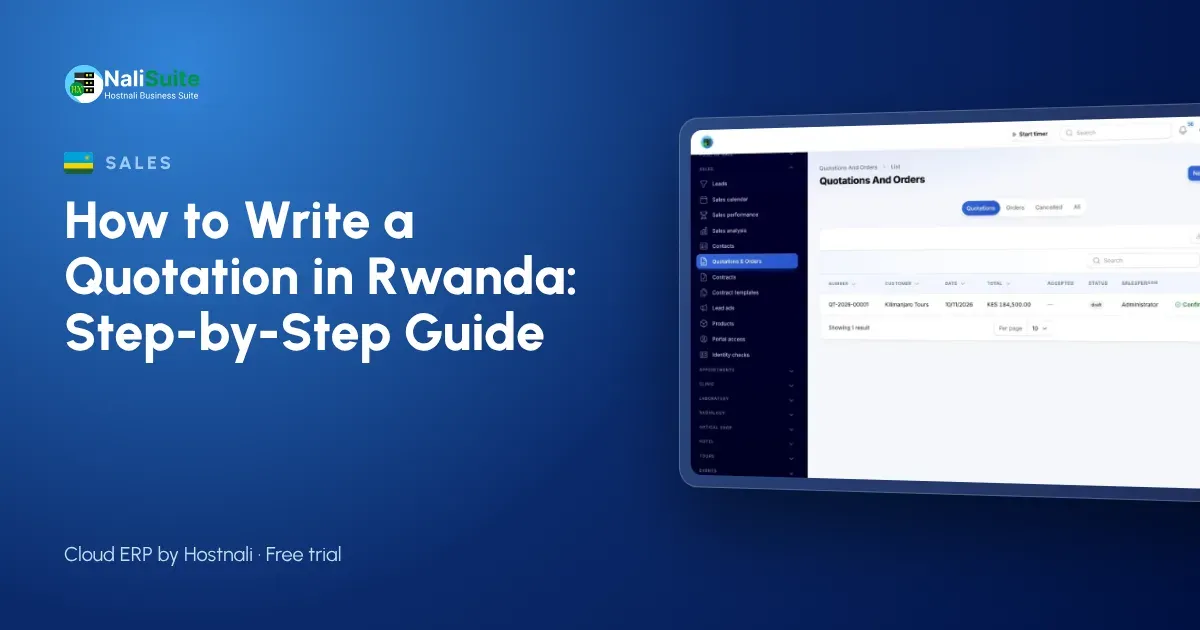
NaliSuite Sales and Quotations fills in your services, prices and VAT, adds optional lines and discounts, and sends a branded quote. The client accepts online with one click and you are notified at once.
Step 6: Follow up and adjust
Two days after sending, check in: did the client receive it, and is anything unclear? If they ask for a lower price, change something real, such as the menu, the number of breaks or the equipment, and issue a revised quote with a new reference.
Keep every quote on a board in the CRM app so you can see what is waiting, won or lost.
Step 7: Turn the acceptance into payment
Once the client accepts:
- confirm the booking in writing;
- invoice the deposit;
- after the event, invoice the balance, adjusting for the final number of participants.
In NaliSuite, the accepted quotation becomes an order and the invoices are created from it, including deposits and partial invoices. Invoices from NaliSuite Invoicing carry a link to pay by MTN MoMo, Airtel Money or card, explained on the mobile money payments page.
Tips for Rwandan businesses
- Quote in Rwandan francs unless the client asks otherwise.
- Match procurement formats. Organisations often send their own forms; fill every field.
- Attach documents when asked: trading licence, TIN or VAT certificates.
- Respect deadlines. A late quote may not be considered at all.
- Write in the language the client used. If the request came in French or Kinyarwanda, consider replying in the same language.
Keep your quotes consistent
Clients in Kigali often compare quotes from the same supplier over time. Use the same layout, numbering and terms on every quote so they can see what changed and why. Keep your standard terms in one place and update them deliberately, not quote by quote. A consistent look also makes it easier for a client’s finance team to process your invoices later.
Frequently asked questions
How long should a quotation be valid?
Long enough for the client to approve it, often two to four weeks. Shorter if supplier prices change often.
Should I charge VAT on a quotation?
Show VAT if you are VAT-registered, so the client knows the full cost. If you are not registered, do not add it.
What if the final quantity is different from the quote?
Agree in the terms that the final invoice follows actual quantities, and invoice accordingly.
Can my client accept the quotation online?
Yes. With NaliSuite the client accepts through a secure link and the acceptance is recorded.
Try NaliSuite
NaliSuite lets Rwandan businesses quote, take deposits and collect by MoMo from one record. Plans start at RWF 3,500 a month with a free trial; see the plans or read about NaliSuite.