 RWF
 KES - Kenya
 UGX - Uganda
 TZS - Tanzania
 NGN - Nigeria
 ZAR - South Africa
 USD - Zimbabwe
 GHS - Ghana
 ETB - Ethiopia
 ZMW - Zambia
 USD - International

Payroll in Rwanda brings together PAYE for the Rwanda Revenue Authority and several RSSB contributions, all due by the 15th of the following month. Each contribution has its own basis, which is where most errors start. This checklist takes them one at a time.
The building blocks
PAYE (monthly)
| Monthly pay | Rate |
|---|---|
| Up to RWF 60,000 | 0% |
| RWF 60,001 to RWF 100,000 | 10% |
| RWF 100,001 to RWF 200,000 | 20% |
| Above RWF 200,000 | 30% |
The first RWF 60,000 a month is tax free. You can test salaries in the PAYE calculator, where every rate can be changed.
RSSB contributions
- Pension: paid by both employee and employer at the current RSSB rate, which is rising in steps to 2030. Keep the rate in your payroll settings up to date with RSSB.
- Maternity leave: 0.3% from the employee and 0.3% from the employer.
- Occupational hazards: 2%, paid by the employer.
Community-based health insurance (CBHI)
0.5% of the employee’s net pay.
Monthly checklist
- Update staff records. TIN, RSSB number, bank or mobile money details, joiners and leavers.
- Enter the month’s changes. Overtime, allowances, unpaid leave.
- Calculate. PAYE on the monthly bands, RSSB pension at the current rate, maternity at 0.3% each, CBHI at 0.5% of net pay.
- Add employer costs. Employer pension, employer maternity and occupational hazards at 2%.
- Approve and pay. Pay salaries by bank or mobile money.
- Send payslips. Show gross pay, each deduction and net pay.
- Declare and pay by the 15th. PAYE declarations to RRA and RSSB contributions, both by the 15th of the following month.
Points that catch employers out
- Using an old pension rate after RSSB raises it.
- Calculating CBHI on gross pay instead of net pay.
- Leaving occupational hazards out of the employer’s cost budget.
- Paying RRA and RSSB on different days and missing one of them.
Records
Keep contracts, payroll summaries, payslips, declarations and payment receipts for each month in one place.
Payroll in NaliSuite
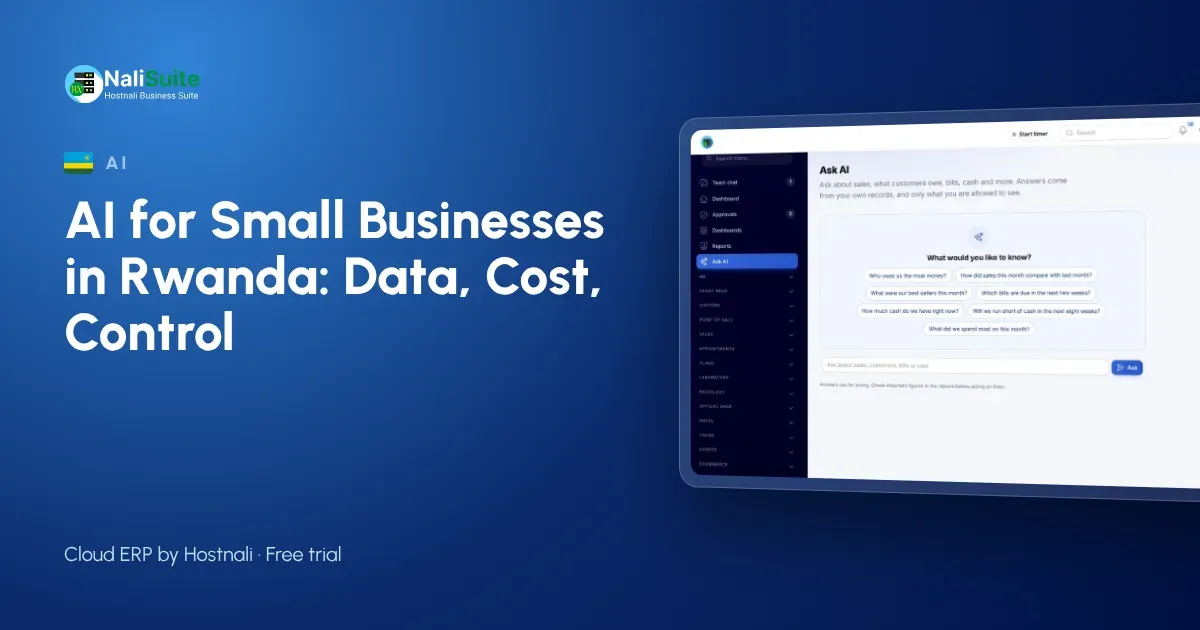
NaliSuite Payroll prepares monthly PAYE declarations and RSSB contribution reports, sends payslips by email or WhatsApp and through the employee app, and creates bank and mobile money payout files. Because rates live in your payroll settings, a new RSSB pension rate is a one-time change. See the PAYE payroll page, and HR for leave and attendance.
Worked example: a pension rate change
A Kigali software company runs payroll for fifteen staff. When RSSB announces the next step in the pension rate, its finance officer follows this checklist:
- Note the date the new rate starts and update the pension rate in the payroll settings for that month.
- Leave earlier months unchanged.
- Check maternity leave contributions are still 0.3% from the employee and 0.3% from the employer.
- Confirm the employer’s 2% occupational hazards contribution is included in the cost.
- Recalculate CBHI at 0.5% of each employee’s net pay, which changes when pension changes.
- Run payroll, review a few payslips by hand and pay PAYE and RSSB by the 15th.
Rwandan payroll mistakes
- Updating the pension rate late, then correcting several months at once.
- Basing CBHI on gross pay.
- Leaving occupational hazards out of the staff budget.
- Filing PAYE but forgetting RSSB, or the other way round.
Paying staff by mobile money
Many Rwandan businesses pay salaries by MTN MoMo or Airtel Money as well as by bank. Build the payment from the approved payroll rather than sending transfers one by one, so every amount matches the payslip and there is a clear record for RRA and RSSB.
Keeping records for RRA and RSSB
Keep each month’s payroll summary, payslips, PAYE declaration and RSSB report together with the payment receipts. When a question comes, you can show exactly how each figure was reached.
New joiners and leavers
When someone joins or leaves part-way through a month, pay them for the days worked and run all deductions on that amount. Register new staff with RSSB before their first payroll, and record the leaving date for anyone who goes, so the next month’s declarations are right.
Frequently asked questions
When are PAYE and RSSB due?
Both by the 15th of the following month.
What is CBHI based on?
0.5% of the employee’s net pay.
Who pays occupational hazards?
The employer, at 2%.
Can payslips be sent in bulk?
Yes. Payslips go out to every employee by email or WhatsApp after each run, and are available in the employee app.
Can staff be paid by mobile money?
Yes. Payroll produces mobile money and bank payout files.
Is the first RWF 60,000 tax free for everyone?
Yes, the first RWF 60,000 of monthly pay is taxed at 0%.
Who pays CBHI?
It is deducted from the employee at 0.5% of net pay.
Try NaliSuite
Keep RRA and RSSB on one timetable. NaliSuite plans start at RWF 3,500 a month with a free trial. View the plans.