 RWF
 KES - Kenya
 UGX - Uganda
 TZS - Tanzania
 NGN - Nigeria
 ZAR - South Africa
 USD - Zimbabwe
 GHS - Ghana
 ETB - Ethiopia
 ZMW - Zambia
 USD - International

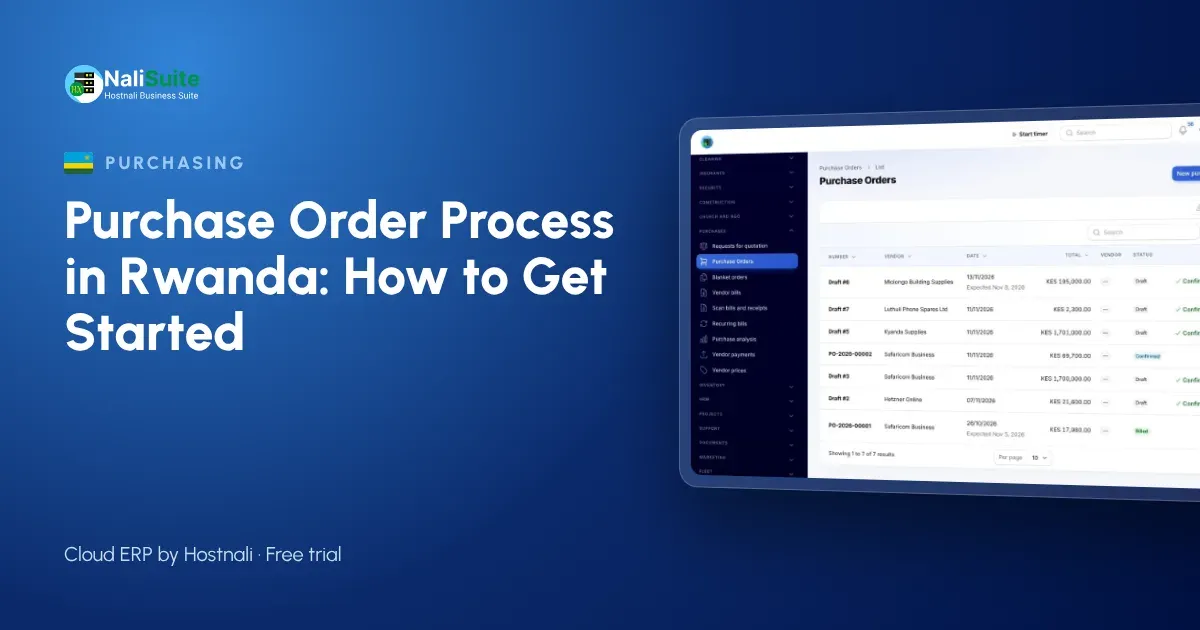
A school in Musanze, a restaurant in Kigali and a construction firm in Rubavu all have the same problem: too many people buying, too few records. A purchase order process gives every purchase a request, an approval and a paper trail.
This guide explains how to set one up for a business in Rwanda.
Signs your buying needs a process
- One person orders, receives and pays. Split the jobs, even in a small team.
- Verbal price agreements. Write the agreed price on the PO.
- Ignoring credit notes. Record them against the supplier so they are deducted from the next payment.
- No reorder levels. Running out of stock leads to rushed, expensive orders.
From request to payment
| Step | Document | Owner |
|---|---|---|
| Need identified | Purchase request | Department head |
| Spending agreed | Approved request | Manager within limit |
| Supplier told | Purchase order | Buyer or office |
| Goods checked | Delivery record | Store or site |
| Supplier paid | Matched bill | Accounts |
Example: a school in Musanze
Take an example private school in Musanze that buys food for the kitchen, stationery for the classes and fuel for the school bus. Teachers and the cook used to buy with cash advances and bring receipts later, when they remembered.
Now each purchase starts as a request, the bursar approves it within the term budget, and suppliers receive a PO. Deliveries are checked by the storekeeper, and suppliers’ EBM invoices are matched to the PO before payment by bank transfer, MTN MoMo or Airtel Money. At the end of term, the head teacher can see spending by department.
Three-way matching
Before any bill is paid, compare it with two other documents. Accountants call this three-way matching:
| Document | What it tells you |
|---|---|
| Purchase order | What you agreed to buy, and at what price |
| Goods received note | What actually arrived, and in what condition |
| Supplier bill | What the supplier is asking you to pay |
When the quantities or prices differ, hold the bill and ask the supplier. A short delivery or a price increase is far easier to sort out before you pay than after.
What a good purchase order shows
Every PO should answer five questions: who is buying, from whom, what exactly, at what price and when it must arrive. Add your payment terms and a unique number, and ask the supplier to quote that number on the delivery note and bill.
Approval limits that keep things moving
Approval limits do not need to be complicated. Two levels are enough for most businesses: a manager for everyday purchases and the owner for anything large or unusual.
VAT and EBM invoices in Rwanda
VAT in Rwanda is charged at 18%. Suppliers issue invoices through RRA’s Electronic Billing Machine (EBM) system. Check that each invoice shows the supplier’s TIN and the VAT correctly, and keep it with the matched bill.
Confirm the current requirements with RRA. NaliSuite lets each business set its own tax rates.
Budgets per term, month or project
Schools, NGOs and project-based businesses in Rwanda usually work to a budget per term, month or project. Linking each purchase request to that budget shows what has been committed before the money is spent.
Approvers see the remaining budget when they review a request, so overspending is caught before the PO goes out, not after the bill arrives.
The bursar or accountant then pays the matched bill by bank, MTN MoMo or Airtel Money, quoting the bill number, and ticks it off at the monthly reconciliation.
For donor-funded projects, tag each request with the grant or project it belongs to. When the funder asks for a spending report, the purchase orders, delivery records and paid bills are already grouped, which saves days of digging through files. See bank and mobile money reconciliation.
Running it in NaliSuite
A system keeps every step connected. In NaliSuite, a request becomes a PO, a delivery updates stock, and the supplier bill lands in accounting already matched. The Purchases app shows what is ordered, received and owed at any moment.
Frequently asked questions
Can I pay suppliers by MoMo in Rwanda?
Most suppliers in Kigali and the provinces take MTN MoMo or Airtel Money, and bank transfer for larger amounts. Whichever you use, link the payment to the bill.
What is an EBM invoice?
An invoice issued through RRA’s Electronic Billing Machine system. Keep the EBM invoice with the PO and delivery record.
What if a supplier delivers more than we ordered?
Accept only what is on the PO, or update the PO first if you want the extra. Otherwise the bill will not match.
Do I need purchase orders for services?
Yes, for regular services such as repairs or transport. The PO fixes the agreed price before the work starts.
Try NaliSuite
NaliSuite runs purchases, inventory and accounting in one cloud ERP, with plans from RWF 3,500 a month and a free trial. See plans and prices.