 RWF
 KES - Kenya
 UGX - Uganda
 TZS - Tanzania
 NGN - Nigeria
 ZAR - South Africa
 USD - Zimbabwe
 GHS - Ghana
 ETB - Ethiopia
 ZMW - Zambia
 USD - International

When a business has one outlet, the owner usually knows by instinct whether it is doing well. When there are two or three, instinct stops working. A mini-market in Kigali’s Kimironko area may be carrying a second shop in Musanze that loses money every month, and nobody sees it because the combined figures still look acceptable.
The profit and loss statement (P&L) is how you see what is really happening, first for the whole business and then for each part of it. This guide covers both.
The whole-business view
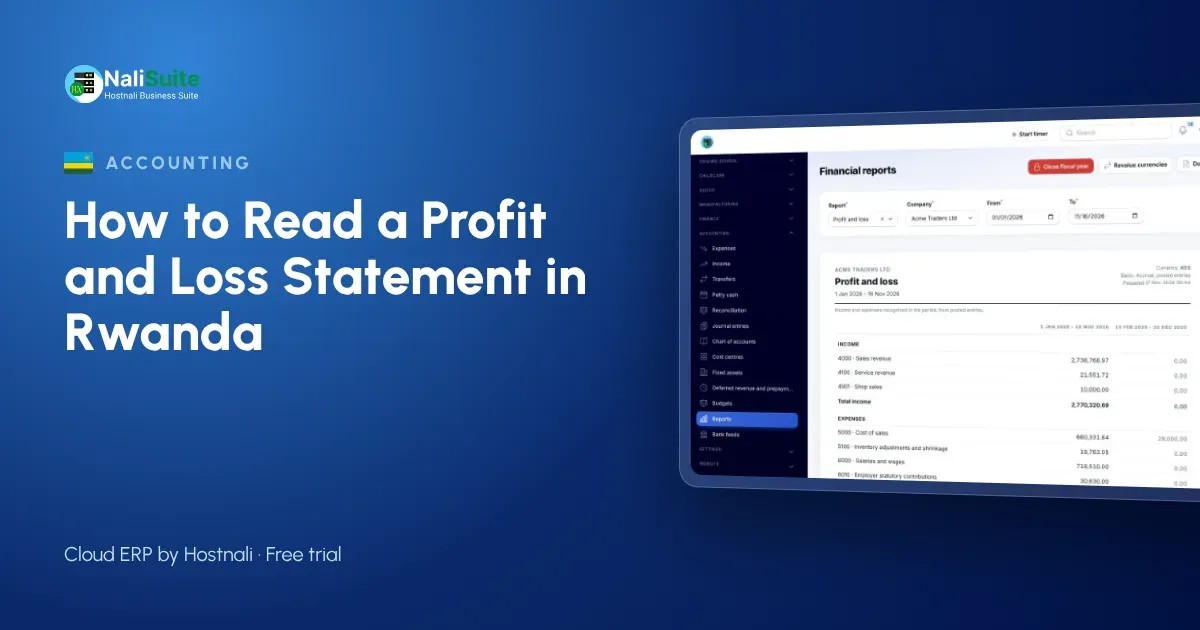
A P&L summarises a period. Its lines, from top to bottom:
- Revenue: sales for the period, excluding VAT if you are registered. VAT you collect is owed to RRA.
- Cost of sales: the cost of the goods or materials you sold.
- Gross profit: revenue minus cost of sales.
- Operating expenses: wages, rent, electricity, transport, phone and internet, MTN MoMo, Airtel Money and bank charges, maintenance, depreciation.
- Operating profit: gross profit minus operating expenses.
- Finance costs and tax: loan interest and the income tax charge. Your accountant works out the tax; check current rules with RRA.
- Net profit: what is left for the owners.
Remember that the P&L is not a cash report. Sales are counted when made, costs when incurred. Our cash flow guide for Rwanda explains how to read cash alongside it.
Three ratios to calculate every month
Francs are hard to compare across months when prices and volumes change. Ratios are easier:
- Gross margin = gross profit ÷ revenue
- Operating margin = operating profit ÷ revenue
- Wages ratio = staff costs ÷ revenue
Write them down each month. After half a year, you have a trend line that tells you more than any single statement.
The per-branch view
Once you have more than one outlet, a single P&L hides as much as it shows. Splitting the statement by branch (accountants call each branch a cost centre) answers questions the combined report cannot.
What to split, and how
- Revenue and cost of sales belong to the branch where the sale happened. A till or invoice that records the branch makes this automatic.
- Direct branch costs, such as that branch’s rent, staff and electricity, go to the branch.
- Shared costs, such as head-office staff, accounting fees or a delivery vehicle serving every shop, can either stay at head office or be shared out on a simple basis such as each branch’s share of sales. Keep the method the same every month.
An example: Claudine’s three shops
Claudine runs mini-markets in Kimironko, Remera and Musanze. Combined, her operating margin is a modest 6%. Split by branch for the last quarter:
| Branch | Gross margin | Wages ratio | Operating margin |
|---|---|---|---|
| Kimironko | 22% | 7% | 10% |
| Remera | 21% | 8% | 8% |
| Musanze | 17% | 12% | –3% |
Musanze has a lower margin, because more stock goes out of date and is thrown away, and the highest wages ratio, because it has the same number of staff on far lower sales. The combined report showed none of this. Claudine’s options are now concrete: cut the range of perishable lines in Musanze, adjust staff hours, or decide whether the branch has a future at all.
What to check before trusting the figures
- Sales recorded at the right branch. Stock transferred between shops should move as a transfer, not as a sale.
- EBM receipts and the books agree. Sales on your electronic billing machine receipts should match revenue in the accounts. Ask RRA which EBM solution your business must use.
- Stock counted at each branch. Without counts, cost of sales per branch is a guess.
- Personal spending kept out. Household costs paid by the business distort every ratio. See our guide on separating business and personal money in Rwanda.
Acting on what you find
- A branch with a low gross margin needs a pricing or stock-loss review.
- A branch with a high wages ratio needs a staffing review, or more sales.
- A branch that loses money for several quarters needs a decision, not hope.
- A business with a healthy P&L but tight cash needs to look at debtors and stock levels.
Getting branch-level figures without extra work
Splitting a P&L by branch in a spreadsheet takes hours each month. In NaliSuite Accounting, every sale, supplier bill and payslip posts to the books as it happens, and cost centres let you see the profit and loss statement for each branch or the whole business, with earlier periods for comparison. The multi-company and branches feature keeps each outlet’s sales and stock separate, the Point of Sale records which branch made each sale, and payroll posts wages to the right branch.
Frequently asked questions
What is a cost centre?
A part of the business, such as a branch, department or project, whose income and costs are tracked separately so it gets its own P&L view.
How should I share head-office costs between branches?
Use a simple, consistent basis such as each branch’s share of sales, or keep shared costs at head office and judge branches on their direct profit.
Is VAT part of revenue?
No, if you are registered for VAT. It is collected for RRA.
How often should I compare branches?
Monthly, with a fuller review each quarter.
Try NaliSuite
See profit for every branch, not just the total. NaliSuite starts at RWF 3,500 a month with a free trial. Compare the plans.