 RWF
 KES - Kenya
 UGX - Uganda
 TZS - Tanzania
 NGN - Nigeria
 ZAR - South Africa
 USD - Zimbabwe
 GHS - Ghana
 ETB - Ethiopia
 ZMW - Zambia
 USD - International

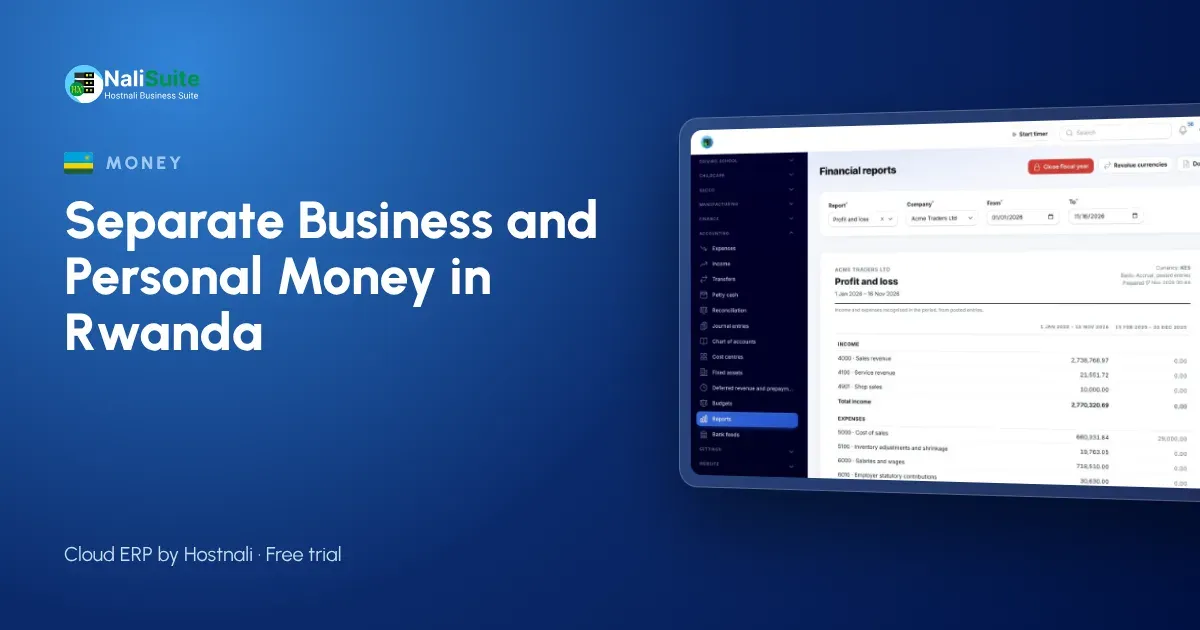
Rwanda has made it easy to start a business: registration with the Rwanda Development Board (RDB) is quick, a TIN comes with it, and customers are used to paying by MTN MoMo or Airtel Money. What registration does not do is separate the owner’s money from the business’s money. That part is up to you, and getting it right early makes everything that follows, from EBM receipts to tax returns to loan applications, far simpler.
This guide sets out the setup piece by piece, then shows how a business in Kigali put it into practice.
The pieces of a clean setup
1. A business payment channel
Customers should pay the business, not you. MoMoPay and similar merchant services give the business its own code to display at the counter, on receipts and on social media. If you are not ready for a merchant code, a second SIM and wallet used only for business is the minimum.
2. A business bank account
Open an account used only for the business. Banks usually ask for your RDB registration certificate and TIN for an account in the business name. Move the business wallet balance into the bank on a set day each week.
3. Owner’s pay on a schedule
Decide how and when you are paid:
- Sole traders transfer a fixed amount to their personal account as drawings. Drawings are not a business expense.
- Company owners who work in the business can be paid a salary through payroll with PAYE and RSSB contributions where they apply; NaliSuite’s PAYE payroll for Rwanda works them out. Ask your accountant how to combine salary and dividends.
Pay yourself on the same day each time. Irregular withdrawals are what make business results unreadable.
4. Personal costs through the personal account
Home rent, school fees, family support and personal shopping are paid from your personal account, funded by your pay. If the business lends you money, record it as a loan and repay it.
5. A document for every transaction
On the sales side, your EBM receipts are the record of what you sold; they should agree with revenue in your books. Ask RRA which EBM solution your business must use. On the cost side, keep the supplier’s EBM receipt or invoice for every business purchase. In NaliSuite Purchases, a photographed supplier bill is read by Document AI so the supplier, lines and tax are filled in for you to check.
6. A weekly check
Every week, go through the business wallet and bank statement and explain every line: a sale, a supplier payment, an expense, a transfer or your pay. Bank and mobile money reconciliation imports the statements and suggests matches, so anything personal stands out.
Putting it into practice: Eric’s print shop
Eric runs a printing and branding shop in Kigali’s Nyabugogo area, producing business cards, banners and branded T-shirts for small businesses and events. Until recently, clients paid deposits to his personal MoMo number, he bought ink and fabric from it, and paid two staff and his family’s bills from it too.
His new arrangement:
| Piece | How Eric set it up |
|---|---|
| Payment channel | MoMoPay code on the counter, quotations and invoices |
| Bank | Business account; MoMo swept every Monday |
| Deposits | Recorded against each job, not treated as general income |
| Owner pay | Salary through payroll on the 25th |
| Staff | Paid with payslips from the business account |
| Records | Supplier EBM receipts photographed on the day |
With clean records, Eric’s monthly profit and loss statement shows that event banners are his most profitable work, while one-off T-shirt orders lose money once reprints and wasted fabric are counted. He sets a minimum order size for T-shirts.
Handling the awkward cases
A customer pays your personal number by mistake. Move the amount to the business wallet the same day and note the reason.
You pay a business cost with personal money. Record it as money the owner put into the business, keep the receipt, and repay yourself from the business account.
Family members work in the business. Pay them an agreed wage through payroll, not informal cash.
Goods taken for home. Record them at cost as drawings.
Why it pays off
- Tax. Income tax is based on profit, and RRA can ask for records. Clean accounts and matching EBM receipts make that straightforward.
- Credit. Lenders read business statements to judge repayment capacity; see our guide to records for a business loan in Rwanda.
- Decisions. You can finally see which products, services or customers make money.
Frequently asked questions
Do I need a merchant code to separate my money?
No, but it helps. A second SIM and wallet used only for business is a good first step.
Are drawings a business expense?
No. They are profit taken out by the owner and do not reduce taxable profit.
How do EBM receipts fit in?
They record sales and supplier purchases. Keeping them and matching them to your books shows that your records are complete. Check your obligations with RRA.
What if I use cash a lot?
Bank cash takings regularly and pay suppliers from the business account rather than from the drawer.
Try NaliSuite
Keep the business on its own books with NaliSuite Accounting, from RWF 3,500 a month with a free trial. Customers can pay by MTN MoMo or Airtel Money from an invoice link. See the plans.