 RWF
 KES - Kenya
 UGX - Uganda
 TZS - Tanzania
 NGN - Nigeria
 ZAR - South Africa
 USD - Zimbabwe
 GHS - Ghana
 ETB - Ethiopia
 ZMW - Zambia
 USD - International

Rwandan businesses have an advantage many neighbours do not: much of their trading already leaves a digital trail. Registration with RDB is online, taxes are declared electronically, EBM receipts record sales, and customers often pay by MTN MoMo or Airtel Money. A lender can, in principle, see a great deal about your business from records that already exist.
The catch is that those records are spread across systems and often mixed with personal transactions. This guide shows how to turn your digital trail into a clear loan application. Banks, microfinance institutions and SACCOs set their own requirements and make their own decisions, so use it to prepare rather than as a guarantee.
The records, grouped by source
From RDB
- Certificate of domestic company registration or business registration, with the current list of shareholders and directors.
- IDs for owners and directors.
- A lease or proof of ownership for your premises.
Keep shareholder and director details current; outdated records can delay an application.
From RRA
- The business TIN.
- Tax declarations filed and paid up to date: income tax, VAT if registered, and PAYE if you employ staff.
- A tax clearance certificate, which many lenders ask for.
From your EBM
Your electronic billing machine records each sale. A summary of EBM sales over recent months, agreeing with the revenue in your books, is strong evidence that your sales figures are complete. Ask RRA which EBM solution your business must use.
From your bank and mobile money provider
- Business bank statements for the period the lender asks.
- MoMo and Airtel Money business statements for the same period.
If customer payments still arrive on a personal wallet with family transfers, the lender sees a smaller, less regular business. Our guide to separating business and personal money in Rwanda explains the setup that fixes this.
From RSSB
If you employ staff, records showing pension and other contributions are paid help show the business is compliant. NaliSuite’s PAYE payroll for Rwanda keeps PAYE and RSSB records month by month.
From your own accounts
- Profit and loss statement and balance sheet for recent years, prepared by an accountant for larger loans.
- Monthly management accounts since the last year-end.
- Aged debtors list: who owes you, how much and for how long.
- Creditors list and a schedule of existing loans.
Our guide to reading a profit and loss statement in Rwanda explains how to read profit per branch, which lenders find useful for multi-outlet businesses.
What you add yourself
The digital trail shows the past. A lender also needs to understand the future:
- Purpose: what the money is for, with quotations or pro-forma invoices.
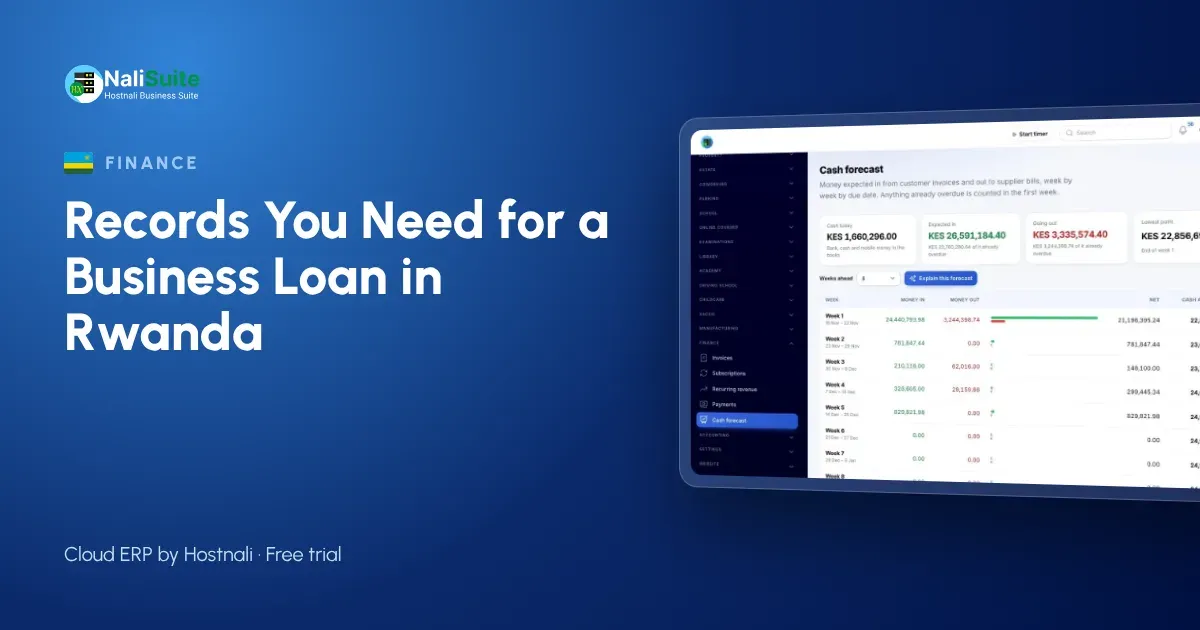
- Cash flow forecast for the loan period, month by month, with repayments included. Our cash flow guide for Rwanda shows how to build one.
- Supporting evidence: contracts, purchase orders or tender awards.
- Security documents, where needed: land title, vehicle registration, equipment invoices, guarantor details.
Lenders also check credit reference bureau records, so keep existing repayments on time.
Checking the trail agrees with itself
Before you apply, compare your sources. They should tell the same story:
| Compare | Should agree because |
|---|---|
| EBM sales and revenue in your accounts | Both record the same sales |
| Bank and MoMo receipts and revenue plus change in debtors | Sales are either paid or still owed |
| Payroll records and staff costs in your accounts | Both record the same wages |
| Tax declarations and your accounts | Declarations are based on your records |
Differences are not always wrong, but you should be able to explain them before the lender asks.
An example: Aline’s dairy business in Nyagatare
Aline collects milk from farmers around Nyagatare, chills it and sells to processors and shops in Kigali. She wants to finance a larger cooling tank and a second delivery vehicle.
Her application drew on:
- RDB company certificate, IDs and the lease on her collection centre.
- RRA tax clearance and up-to-date declarations.
- EBM sales summaries for twelve months.
- Twelve months of business bank and MoMo statements, with farmer payments clearly recorded.
- Two years of accounts and monthly management accounts.
- A debtors list showing the processors pay on agreed terms.
- Quotations for the tank and vehicle, a forecast based on her supply agreements, and the vehicle as security.
Because the sources agreed, the lender’s questions were about milk volumes and the processor contracts.
Keeping the trail tidy
NaliSuite Accounting records every sale, supplier bill and payslip as it happens, so profit and loss, balance sheet and cash flow statements are always current. Invoicing keeps the aged debtors list, bank and mobile money reconciliation matches statements to the books, and Documents stores RDB papers, tax certificates and contracts in one place to share securely.
Frequently asked questions
Do lenders accept mobile money statements?
Many consider them alongside bank statements. Ask the lender.
Do I need audited accounts?
Smaller loans are often assessed on statements and management accounts; larger ones more often need accountant-prepared or audited accounts.
What if my EBM sales and my accounts do not agree?
Find the reason before applying, for example sales recorded in the wrong month, and correct it.
Will a tidy digital trail guarantee a loan?
No, but it makes your application easier and faster to assess.
Try NaliSuite
Keep your records lender-ready all year. NaliSuite starts at RWF 3,500 a month with a free trial. See the plans.